
When do ChatGPT Ads launch in Belgium and Europe?
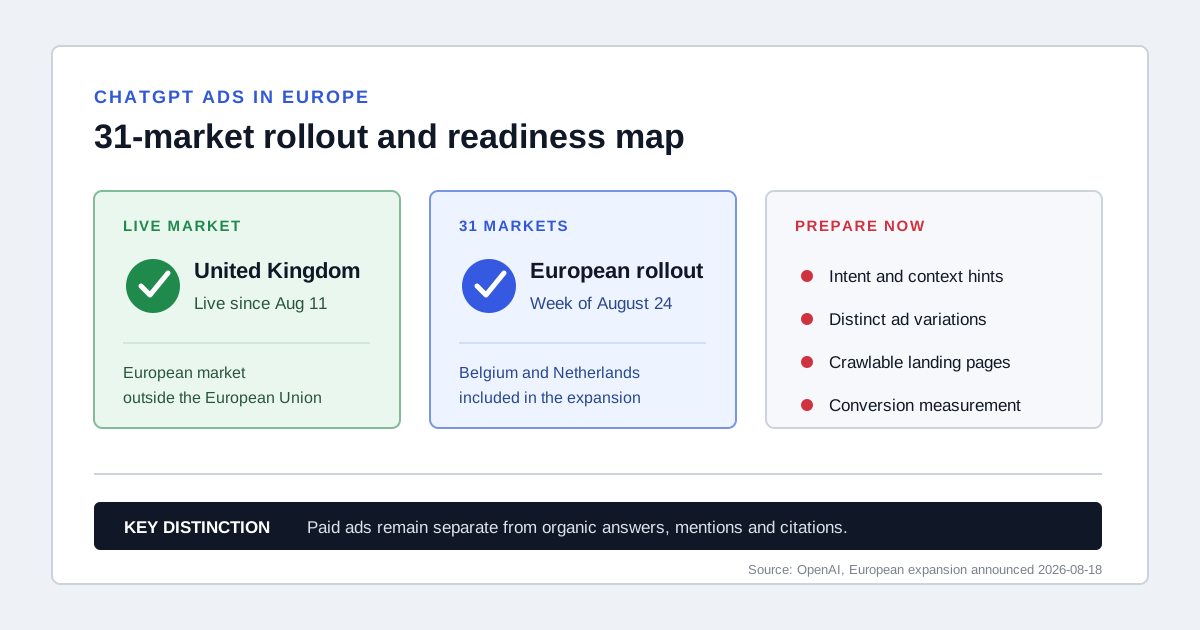
OpenAI has announced that ChatGPT Ads will expand to 31 European markets in the week of August 24, 2026. Its announcement names Germany, France, Spain, Italy, Sweden, Norway, Denmark, the Netherlands and Austria among the participating countries. Belgian technology publication ITdaily confirms that Belgium is included as well.
The expansion covers both ad delivery to eligible users and a new channel for European advertisers. At launch, campaigns will be available through OpenAI's Ads Solutions team, agency partners and technology partners. Direct self-service through Ads Manager will follow later this summer.
Jakency covers market readiness, pilot design and revenue measurement on its dedicated ChatGPT Ads agency service page. Organic source visibility remains separate and is measured through GEO.
| Market | Status on August 20, 2026 | Practical meaning |
|---|---|---|
| United Kingdom | ChatGPT Ads already available | Existing European market outside the EU |
| Belgium | Rollout in the week of August 24 | Initial access through OpenAI and selected partners |
| Netherlands | Rollout in the week of August 24 | Initial access through OpenAI and selected partners |
| European expansion | 31 markets | Largest geographic expansion to date |
What capabilities are available in the European rollout?
OpenAI has expanded the advertising platform since its initial US test. Beyond CPM and CPC buying, it now supports conversion optimization, geo-targeting and custom audiences. The OpenAI Pixel, Conversions API and third-party measurement integrations allow advertisers to measure more than clicks alone.
These capabilities make ChatGPT Ads more than a basic sponsored link, but the channel remains young and lacks stable European benchmarks. OpenAI says tens of thousands of marketers have advertised on ChatGPT, without publishing comparable outcomes by country, industry or campaign objective. A controlled pilot is therefore more useful than a generic average.
What are ChatGPT Ads?
ChatGPT Ads are clearly labelled paid placements that can appear below a ChatGPT response. An ad includes the advertiser name, favicon, headline, description, landing page and image asset. OpenAI says the ad system remains separate from the model response.
The current test focuses on adult users of Free and Go. Plus, Pro, Business, Enterprise and Edu accounts do not receive ads under the current rules. Accounts that OpenAI knows or predicts belong to someone under 18 are excluded from the test as well.
How does ChatGPT choose which ad to show?
ChatGPT Ads uses expected relevance and outcomes rather than relying only on a typed keyword. OpenAI lists the current conversation's context and intent, the landing page, headline, copy, advertiser context hints and, when ad personalization is enabled, selected signals from the user's broader ChatGPT experience.
Context hints describe conversations, problems, topics and terms where an offer may be useful. They function more like a combination of theme, audience situation and intent than a keyword match type. An accounting software ad group could cover invoice processing, VAT preparation and finance automation without targeting one exact phrase in every conversation.
| Element | Google Search Ads | ChatGPT Ads |
|---|---|---|
| Primary context | Search query and keyword targeting | Conversation intent and context |
| Targeting signal | Keywords, audiences and locations | Context hints, ad and landing page |
| Placement | Around search results | Below a ChatGPT response |
| Organic influence | No payment for organic ranking | No payment for an answer or citation |
How can European advertisers prepare now?
Prepare the intent model, creative variations, landing pages and measurement before access opens. Waiting for an Ads Manager button leaves campaign strategy, consent and technical validation until the most expensive moment.
- Choose one commercial objective for each campaign, such as leads, registrations or sales.
- Separate ad groups by product, audience, problem or use case.
- Write context hints as natural needs and conversation themes.
- Create distinct headlines, descriptions and images that test different arguments.
- Match every ad group to a specific and relevant landing page.
- Define UTM parameters, conversions, consent and reporting in advance.
- Verify that OpenAI can crawl every landing page.
Existing Google Ads search term and conversion data can reveal customer language, problems and commercial intent. Do not clone the campaign structure mechanically. ChatGPT context hints should describe the situation and need behind a query as well as the vocabulary people use.
What must a ChatGPT Ads landing page support?
The landing page must be publicly accessible, consistent with the ad and crawlable by OAI-AdsBot. OpenAI uses this crawler to validate ad destinations and may use landing page content to understand when an ad is relevant.
User-agent: OAI-AdsBot
Allow: /

User-agent: OAI-SearchBot
Allow: /
Robots.txt is only the first layer. Check whether a WAF, CDN, bot protection rule, CAPTCHA, login, geo restriction or JavaScript challenge returns a 403, 429 or empty page. The page should explain the offer, intended customer and next action clearly. The same principle underpins effective lead generation landing pages.
How much do ChatGPT Ads cost?
ChatGPT Ads currently supports CPM and CPC buying, but there is no dependable EU pricing benchmark yet. Reach campaigns pay per thousand impressions. Click campaigns pay per valid click. OpenAI uses a relevance-weighted second-price auction to select eligible ads.
A future test should not be judged by CPC alone. A conversation may indicate richer consideration than a broad search query, but only campaign data can prove that. Measure ad cost, qualified visits, conversions, lead quality and revenue. OpenAI says the beta does not yet have general performance benchmarks across industries or campaign types.
How should advertisers measure ChatGPT Ads?
Measure ChatGPT Ads through Ads Manager, your analytics platform and conversion data. Ads Manager reports impressions, clicks, spend, CTR, average CPC, average CPM and configured conversions. Static and dynamic URL parameters can identify traffic by campaign, ad group and ad.
OpenAI supports a Pixel, Conversions API and a click reference called oppref. Preserve that reference through redirects and later navigation. When the same conversion is sent from browser and server, use the same event ID so it can be deduplicated.
| Measurement layer | Decision question | Examples |
|---|---|---|
| Delivery | Is the campaign serving? | Impressions, spend, CPM |
| Interaction | Do relevant users click? | Clicks, CTR, CPC |
| Website | Does the landing page match intent? | Engagement, form start, checkout |
| Business result | Does the channel create value? | Lead quality, revenue, margin, lifetime value |
Will ChatGPT Ads replace SEO or GEO?
No. A ChatGPT ad is a paid and labelled placement below an answer. An organic mention or citation comes from the sources and systems used to produce the answer. OpenAI explicitly says advertisers cannot influence ChatGPT responses.
Keep three reporting streams separate: paid ad delivery, organic referral traffic and mentions or citations without a click. Our guide to visibility in ChatGPT covers the organic source layer. The method for measuring AI visibility uses fixed prompts and source checks rather than ad reporting.
What privacy review do European campaigns need?
European businesses should determine what data their Pixel, Conversions API, analytics and forms process before implementation. OpenAI states that conversion data should only be shared when permitted, after users receive clear information and any required consent has been obtained.
Marketing, development and privacy teams should agree which events are necessary, how consent works and how data is retained. Technical availability is not a reason to send every possible signal. Use only data that is necessary, permitted and documented for the selected campaign objective.
What should European businesses do next?
Decide whether to enter during the initial partner-led rollout or wait for self-service Ads Manager access. In either case, design one focused pilot with a clear offer, several creative angles, a matching landing page and one primary conversion. This creates a clean test of the channel's commercial value.
Use the first campaign to evaluate channel fit rather than replacing SEO or paid search immediately. Compare qualified leads and revenue with other channels over the same period. The strongest first step is a measurable pilot with explicit stop, learning and scaling criteria.
Which sources support this guide?
The status and product details were checked on August 20, 2026. The official OpenAI pages remain the source of truth because availability and beta features can change quickly.