
Updated on
What does a multilingual SEO agency do?
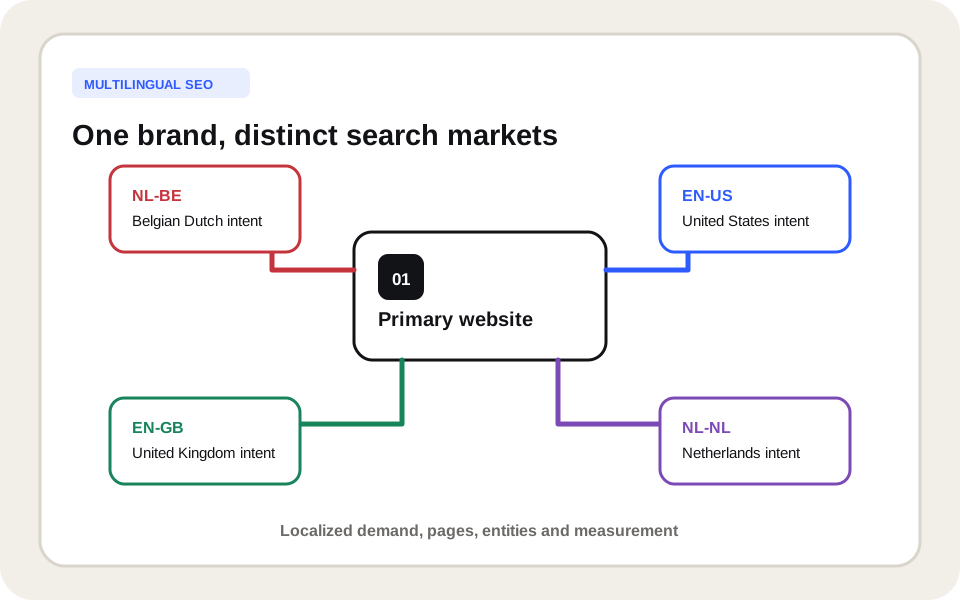
A multilingual SEO agency maps demand in each language and market to the right page, then improves content, technical signals, internal links and measurement. The work goes beyond translation because vocabulary, competitors, expectations and conversion paths can differ by country.
Companies deciding which countries to enter, which architecture to use and how to phase expansion should start with international SEO services. This page owns the language, localization and multilingual quality workflow.
Jakency combines SEO services, technical implementation, content and GEO so that localized sources remain clear for Google and AI search systems.
When do you need multilingual SEO?
You need multilingual SEO when customers search for the same offer in different languages or when one language serves markets with different commercial intent. It is especially relevant when a translated site receives impressions but does not attract qualified traffic or enquiries.
- Your business serves Dutch, English, French or other language audiences.
- The same service is described with different terms in different countries.
- Generic translations rank for irrelevant locations or weak intent.
- Language versions compete because canonicals or hreflang are inconsistent.
- One global report hides which markets create qualified leads.
How is multilingual SEO different from translation?
Translation preserves meaning between languages. Multilingual SEO also adapts the page to local demand, search terminology, entities, competitors, evidence and the intended next action. A linguistically correct translation can still target the wrong query or provide an offer that does not fit the country.
| Layer | Translation | Multilingual SEO |
|---|---|---|
| Language | Meaning and readability | Meaning, terminology and real query language |
| Intent | Usually follows the source page | Validated separately per market |
| Structure | Mirrors the original site | Can differ when local demand requires it |
| Evidence | Translates existing proof | Selects proof relevant to the target market |
| Measurement | Often page delivery | Queries, visibility, conversions and lead quality |
Which international site structure should you choose?
Choose a structure that gives every language-market combination one stable URL and can be maintained consistently. Folders on one domain, subdomains and country domains each have operational and authority trade-offs.
| Structure | Strength | Risk |
|---|---|---|
| example.com/en/ | Authority and maintenance remain on one domain | Country targeting must be clear in content and signals |
| en.example.com | Technical or organizational separation | More systems and weaker internal cohesion |
| example.nl or example.be | Strong country identity | Separate authority, content and operations per domain |
Jakency uses language folders on one domain for this website. That keeps Dutch and English sources connected while each page retains its own canonical, language metadata, internal links and localized search intent.
How should hreflang and canonicals work together?
Each localized page should normally use a self-referencing canonical and reciprocal hreflang links to genuine alternatives. Hreflang helps search engines select the most suitable language or regional version, while the canonical identifies the preferred URL within that version.
- Do not canonicalize every translation to the source-language page.
- Only connect pages that are real alternatives for the same purpose.
- Use valid language and optional region codes such as en, en-US or nl-BE.
- Keep links reciprocal and include localized pages in the XML sitemap.
- Send visitors to the correct page without forcing an irreversible redirect.
How do you research keywords across countries?
Research starts with first-party query data, customer language and the current results for each target country. A direct translation is treated as a hypothesis, not as proof that people use the term or expect the same page type.
- Separate queries and landing pages by country and language in Search Console.
- Cluster variants that share intent and keep distinct decisions separate.
- Inspect which page types rank in the target market.
- Map one primary page to each independent intent.
- Validate terminology with a native or market-aware reviewer.
- Prioritize queries that can contribute to a qualified enquiry or sale.
How do you localize entities and evidence?
Localize entities by keeping core facts consistent while adapting market-specific attributes such as service area, language, offer, legal context and relevant proof. Organization and Person identities should remain stable across versions, while service pages explain where and for whom the work is available.
The pages about Jakency and Jan Kenis provide stable company and expert sources. Project and case pages provide the evidence layer.
What does a multilingual SEO project deliver?
A multilingual SEO project should deliver a market map, localized keyword and intent clusters, a URL plan, technical language requirements, page briefs, internal links and a measurement framework. The exact scope depends on existing content and internal review capacity.
| Deliverable | Decision it supports |
|---|---|
| Market and language scope | Where the first investment should go |
| Query and intent map | Which pages to improve, create or merge |
| URL and hreflang plan | How search engines connect localized versions |
| Localized page briefs | What each page must answer and prove |
| Quality checklist | Who verifies language, facts, links and conversion |
| Measurement plan | How visibility and leads are compared per market |
How do you measure international SEO performance?
Measure every market separately before combining results. Use Search Console for queries, impressions, clicks and landing pages, analytics for engagement and conversions, and CRM data for qualified leads, revenue and sales feedback where available.
A market with less traffic can still be more valuable when its visitors convert or lead to better customers. Reporting should therefore connect country, language, landing page and commercial outcome instead of using global organic sessions as the main success metric.