
Published on
What is an SEO strategy?
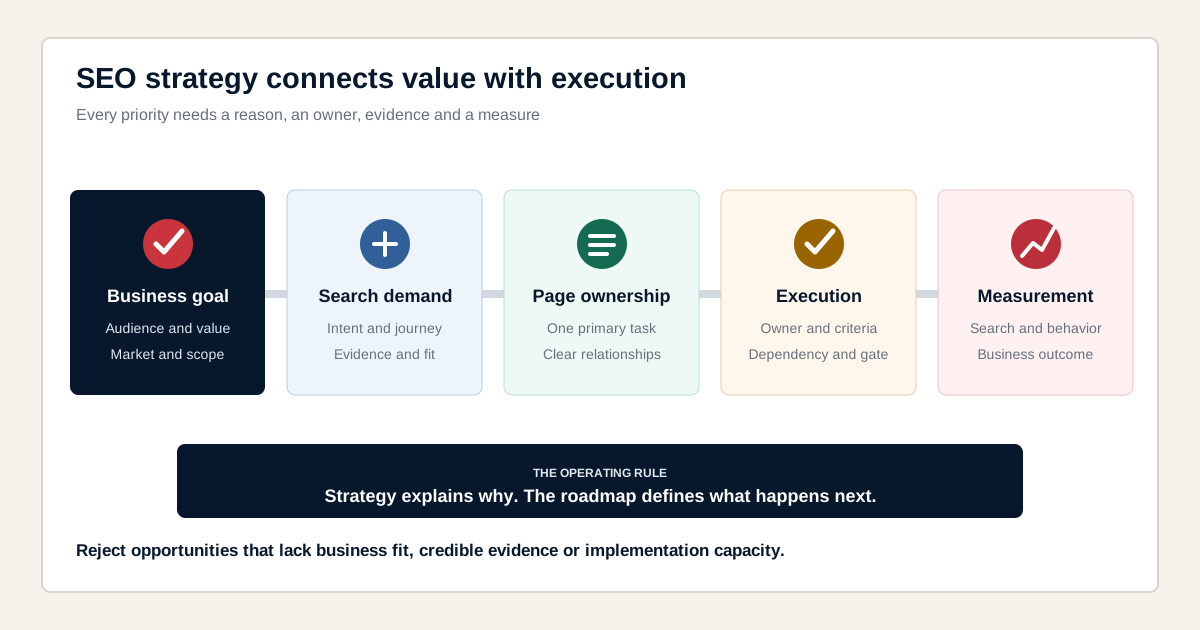
An SEO strategy is the decision framework that connects an organization's current organic position with a desired business outcome. It explains what the organization will prioritize, what it will postpone, why those choices are credible and how the team will learn from execution.
| Starting point | Business goals, markets, audiences, offer, website and current performance |
|---|---|
| Strategic choices | Demand, differentiation, intent, page ownership, technology, content, authority and GEO |
| Execution model | Roadmap, owner, dependency, deadline and acceptance criterion |
| Measurement | Implementation, technical quality, search visibility, customer behavior and commercial outcome |
| Result | A documented priority system, not a collection of unrelated SEO tactics |
Jakency provides SEO strategy services for organizations that need to choose between several markets, products, services, page types or technical investments. The strategy can guide an internal team, a hybrid collaboration or a managed SEO program.
Why does SEO need a documented strategy?
SEO needs a documented strategy because every website has more possible actions than available time, budget and implementation capacity. A crawl can return hundreds of issues, keyword research can return thousands of phrases and an SEO competitor analysis can reveal dozens of content gaps. Strategy decides which evidence matters to the business.
Documentation creates a shared reference for management, marketing, content, development, sales and external partners. It makes assumptions visible, sets realistic expectations and records the resources required. It also allows the organization to distinguish a deliberate change in direction from a reaction to one volatile ranking or tool score.
What is the difference between a goal, strategy, plan and roadmap?
A goal defines the desired outcome, strategy defines the chosen route, a plan describes the work and a roadmap sequences that work through time and dependencies. Treating those objects as interchangeable usually creates a list of tasks without a reasoned choice.
| Object | Central question | Example output |
|---|---|---|
| Business goal | What meaningful result should change? | More qualified pipeline from a priority market |
| SEO strategy | Where will organic search create that result, and why can we win? | Focus on evidence-led commercial clusters for one audience |
| SEO plan | Which projects and workstreams deliver the strategy? | Technical foundation, page improvements, new sources and authority |
| SEO roadmap | What happens first, who owns it and what unlocks the next phase? | Sequenced releases with phase gates and review dates |
| Backlog | Which approved tasks remain available for execution? | Tickets with owners, evidence and acceptance criteria |
What is the difference between an SEO audit, strategy and SEO services?
An audit describes the current condition, a strategy makes choices and SEO services deliver defined specialist work. All three can belong to one engagement, but each needs its own output and acceptance criteria.
| Component | Central question | Primary deliverable |
|---|---|---|
| SEO audit | What is happening now and what blocks progress? | Evidence, risks and opportunities |
| SEO strategy | Where will we focus and why? | Choices, principles and priorities |
| SEO roadmap | In which order can the strategy be executed? | Phases, owners, dependencies and gates |
| SEO services | Which specialist work should be performed? | Analysis, specification, content or implementation |
| Review cycle | What changed and what should happen next? | Measurement, decision and reprioritized backlog |
When does a business need an SEO strategy?
A business needs an SEO strategy when organic opportunities compete for resources or affect several teams and systems. A small site with one clear service may only need a focused audit and action plan, but strategic choices become important as complexity increases.
- The website serves several products, services, countries, languages or locations.
- Marketing, content and development use different priorities.
- Many SEO ideas exist, but their business value and evidence are unclear.
- New pages overlap with existing URLs or create keyword cannibalization.
- Technical recommendations remain unimplemented because ownership is missing.
- Organic traffic grows while qualified leads, revenue or margin do not.
- A migration, redesign, new platform or international expansion is planned.
- SEO and GEO need one shared source architecture with separate channel measurement.
Which information is required before strategy work begins?
A useful SEO strategy starts with business and customer information before keyword tools. Jakency needs to understand what the organization sells, who should buy it, where the company can deliver, which transactions matter and which constraints affect execution.
- Priority products, services, markets, locations and audiences.
- Revenue model, margin context, sales cycle and qualified conversion definitions.
- Google Search Console, analytics, CRM or revenue data where available.
- CMS, platform, deployment process and technical restrictions.
- Existing research, campaigns, content calendars and planned changes.
- Available subject experts, writers, developers and decision makers.
- Brand, legal, privacy or compliance boundaries that affect publication.
Missing information is recorded as an uncertainty rather than silently replaced with an assumption. The strategy identifies which decisions need more evidence and which actions can safely start with the available data.
How do you connect SEO with a business goal?
Connect SEO with a business goal by defining the audience, valuable action, market and measurement before selecting queries or pages. Position one is not a business goal, and more organic traffic is useful only when it supports a meaningful customer or organizational outcome.
| Business goal | Strategic search question | Appropriate measurement |
|---|---|---|
| More qualified leads | Which problems and services lead to a valuable sales conversation? | Qualified forms, calls, pipeline and closed revenue |
| More ecommerce revenue | Which categories combine demand, availability, margin and customer fit? | Revenue, margin, new customers and returns |
| Enter a new country | Which local intent, language, competitors and proof apply? | Visibility and conversions per market |
| Build category authority | Which knowledge and evidence can the organization credibly own? | Branded demand, relevant mentions, links and assisted conversions |
Scope also needs exclusions. A strategy that tries to target every market, audience and funnel stage at once avoids the choices that strategy exists to make.
How do you establish an SEO baseline?
Establish an SEO baseline by recording current discovery, crawling, indexation, query performance, page performance and commercial outcomes with dates, filters and data limitations. One visibility score from an external tool is not a complete baseline.
- Which canonical pages are crawlable, indexable and present in useful internal paths?
- Which queries and pages receive impressions, clicks and conversions?
- Which pages are gaining, declining or competing with one another?
- Which technical patterns affect important templates or market sections?
- Which content has evidence, current facts and an accountable owner?
- Which external mentions and links support a genuine reputation?
Google documents Search Console as the source of truth for Google Search performance and Google Analytics as a source for on-site behavior. Their numbers use different measurement systems and should be interpreted as related evidence rather than expected to match exactly.
How do you map search demand, intent and the customer journey?
Map search demand by clustering customer language around the task, decision stage and expected page type. Search volume can support prioritization, but it must be combined with customer value, conversion likelihood, feasibility, proof and existing traction.
Research definitions, problems, solutions, comparisons, alternatives, prices, risks, locations and concrete buying questions. Include keyword research, Search Console, site search, sales calls, customer support, paid-search terms and local SERPs. First-party sources often reveal terminology and objections that external databases miss.
Query fan-out can reveal useful follow-up questions, but it should not be copied into one page without judgment. Some questions belong as sections, some belong on supporting pages and others do not match the business or page intent.
How do you assign page ownership?
Assign page ownership by giving every independent search task one primary URL. Synonyms and close variants with the same intent usually belong on the same page. A separate page is justified when the user expects different products, services, evidence, geography, decision criteria or a different primary action.
| Decision | Evidence to inspect | Preferred response |
|---|---|---|
| Same intent and same offer | Comparable SERPs, criteria and conversion task | Use one strong primary page |
| Different commercial task | Different offer, audience or decision criteria | Create or preserve a distinct page |
| Existing pages compete | Queries rotate between similar URLs | Select an owner and consolidate signals |
| Demand exists without a suitable page | Relevant SERP and clear business fit | Build a new primary source page |
| Demand lacks business relevance | Volume without offer, expertise or conversion path | Exclude the topic from the strategy |
The resulting map records the existing URL, intended owner, query cluster, customer task, conversion, supporting pages and internal links. This prevents a blog post, service page and location page from targeting the same core problem without a reason.
How do you define the technical SEO strategy?
Define technical SEO strategy by connecting technical patterns with valuable pages, templates and future growth. A warning that blocks indexation of core pages should take priority over a cosmetic issue on URLs without demand or business value.
Document decisions for crawling, rendering, canonicals, redirects, sitemaps, pagination, faceted navigation, structured data, internal links, Core Web Vitals and migrations. Convert each decision into a development requirement with representative URLs, expected behavior, an acceptance criterion and a validation method. The technical SEO hub covers the individual work areas.
How do content strategy, evidence and information gain fit?
Content strategy defines which source pages support the business topic and customer journey, while evidence and information gain explain why those pages deserve attention. Start with primary service, product, category, location or entity pages, then add supporting content only when it answers a real question and has a logical next step.
Google advises creating helpful, reliable, people-first content and asks whether a page adds original information, research or analysis beyond obvious summaries. The SEO strategy should therefore identify subject experts, first-party data, case evidence, original visuals, calculations, tools or a stronger decision framework before scaling publication.
The SEO content strategy explains clusters and publishing in more detail. The wider SEO strategy also records who supplies expertise, which claims need proof, when facts must be reviewed and which URL remains the primary source.
How should authority and external signals be planned?
Plan authority by identifying which organizations, experts, platforms and publications can credibly confirm the brand in a relevant context. Useful sources may include trade associations, partners, customers, suppliers, local profiles, original research, project cases and editorial coverage.
Build information or proof that a relevant party has a reason to reference. Link building and digital PR should follow the reputation, audience and source value required by the strategy. A target number of generic backlinks does not explain which page, entity or business claim the work is meant to strengthen.
How do SEO, AI search and GEO fit into one strategy?
SEO and GEO share a technical and source foundation but use different channel controls and measurements. Crawlable pages, explicit entities, current facts, authorship and evidence can support both classic search and generative systems, but a Google ranking does not guarantee an AI mention or citation.
Google Search Console measures Google Search and the generative features available in its reports. ChatGPT, Perplexity and other external systems require separate prompt sets, mention tracking, citation review and referral analysis. A GEO strategy defines that source position and AI measurement cycle.
How should SEO opportunities be prioritized?
Prioritize SEO opportunities by combining business impact, strength of evidence, useful scale, dependencies and effort. The score makes an argument visible, but it does not replace judgment. A low-volume technical issue may still come first when it affects every future page.
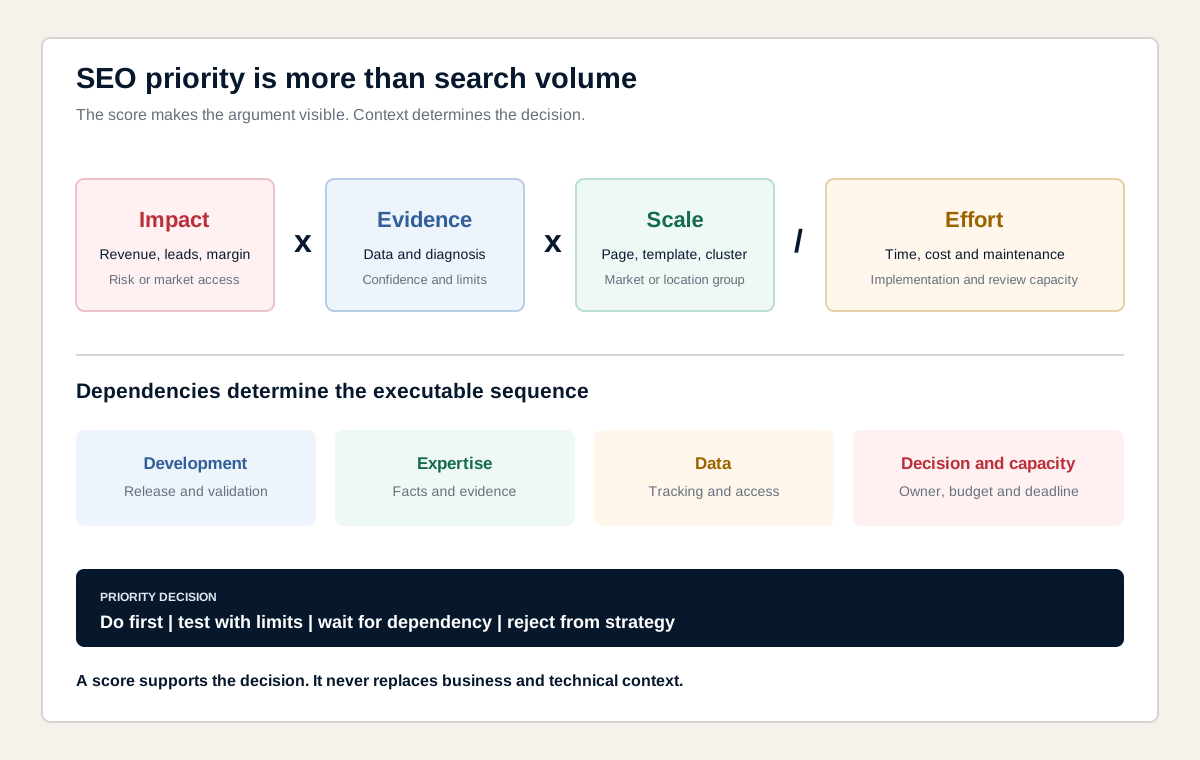
| Factor | Decision question | Useful evidence |
|---|---|---|
| Business impact | Which meaningful outcome could change? | Revenue, qualified leads, margin, risk or market access |
| Evidence | Why do we expect this action to help? | Search Console, crawl, conversions, SERPs or user research |
| Scale | How many valuable pages or markets are affected? | Template, cluster, category, language or location group |
| Dependency | What must be resolved before this can succeed? | Development, data, expert review, tracking or approval |
| Effort | Which capacity, cost and maintenance are required? | Hours, releases, external cost and recurring ownership |
Which diagnosis should determine the first strategic action?
The first strategic action should address the strongest evidenced constraint rather than the most visible item in a tool. Different patterns require different responses, and publishing more pages is often the wrong default.
| Observed signal | Likely first action | Avoid doing first |
|---|---|---|
| Many impressions with weak CTR | Review intent, title, snippet and SERP presentation | Create a page for every query variation |
| Relevant pages are not indexed | Resolve crawling, canonical and indexation patterns | Scale content production |
| Visibility grows but conversions do not | Review offer, customer task, tracking and lead quality | Chase more traffic without diagnosis |
| Several URLs serve the same intent | Select the primary owner and consolidate signals | Publish another overlapping page |
| Strong demand lacks a suitable page | Build a primary page with proof and a clear task | Hide the intent inside a general article |
| Demand has no business or expertise fit | Reject the topic or reconsider the channel | Force SEO because a tool reports volume |
What makes an SEO roadmap executable?
An SEO roadmap becomes executable when every phase has an outcome, owner, dependency, acceptance criterion and gate for the next decision. It should not pretend that every organization needs the same three, six or twelve-month calendar.
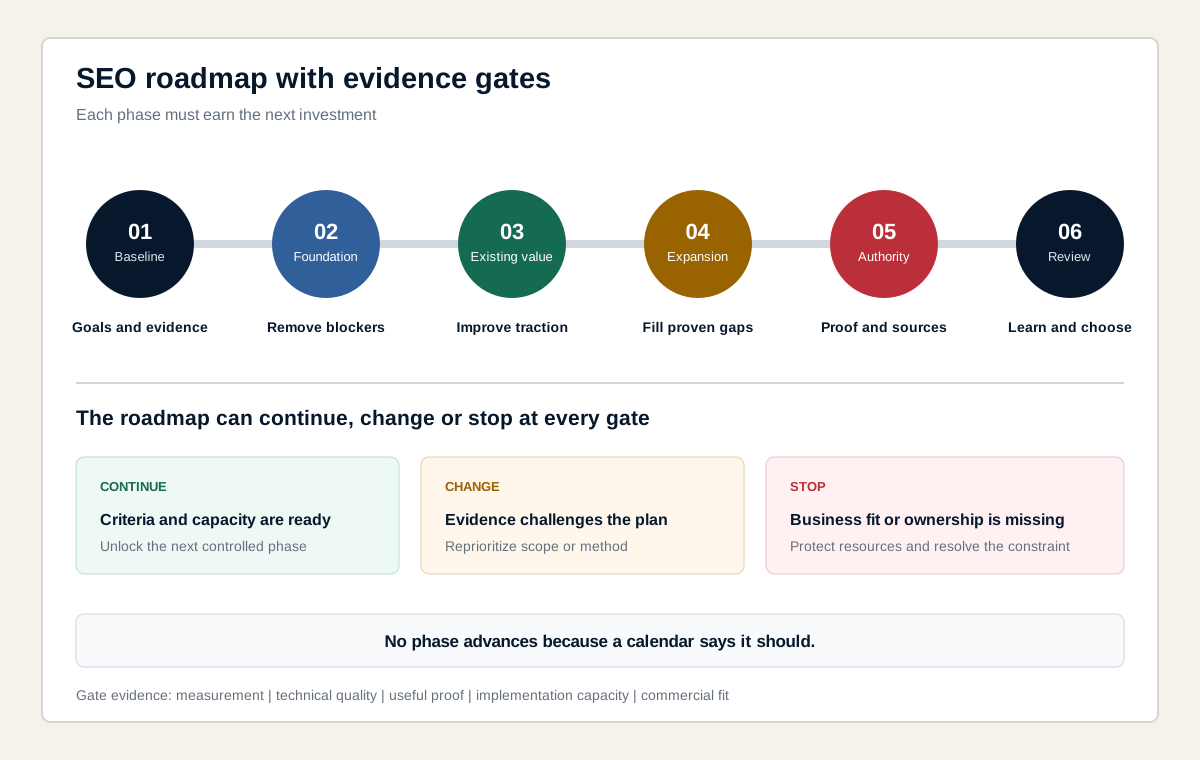
- Baseline: document goals, data, page ownership, technical conditions and current results.
- Foundation: resolve material blockers in crawling, indexation, templates, measurement and architecture.
- Existing opportunities: improve pages that already have relevant impressions, links, engagement or conversions.
- Focused expansion: create missing primary and supporting pages without duplicating intent.
- Authority: strengthen expertise, proof, cases and relevant external references.
- Review: compare releases with outcomes, record what was learned and reprioritize the backlog.
Which phase gates and stop criteria should a roadmap use?
Phase gates should stop expansion when foundations, evidence or operational ownership remain inadequate. A strategy protects resources by defining what must be true before another content batch, market or technical project receives investment.
| Gate | Continue when | Pause or change when |
|---|---|---|
| Measurement gate | Important conversions and releases can be interpreted | No one can distinguish valuable outcomes from raw traffic |
| Technical gate | Representative pages are crawlable, indexable and rendered correctly | A shared template blocks the planned cluster |
| Evidence gate | Experts, data or proof can support the intended claims | Pages would only summarize competitors without added value |
| Capacity gate | Named owners can publish, review and maintain the work | The existing backlog remains unimplemented |
| Commercial gate | The market and offer can produce a valuable customer outcome | Demand exists but the organization cannot serve it well |
Who is responsible for an SEO strategy?
The SEO lead owns coherence, but several roles own the decisions and implementation required by the strategy. Management defines the goal and resources, experts supply evidence, content creates useful pages, development implements technical rules and sales or operations validates commercial quality.
| Role | Primary responsibility |
|---|---|
| Management or growth lead | Business goal, market scope, budget and acceptable risk |
| SEO lead or agency | Research, choices, page ownership, priorities and quality assurance |
| Subject expert | Facts, experience, source material and claim approval |
| Content and brand | Briefs, production, consistency, updates and internal links |
| Development | Technical implementation, release and test evidence |
| Sales or operations | Lead quality, product reality, margin and recurring customer questions |
| Analytics | Definitions, event quality, dashboards and measurement limitations |
What should an SEO decision ledger contain?
An SEO decision ledger should record the reason, evidence, owner and observed result for every material strategic choice. It prevents the roadmap from losing its logic after staff changes, new agencies or unexpected performance movements.
| Ledger field | Purpose |
|---|---|
| Problem and affected scope | Define what is wrong and which pages, users or markets are involved |
| Hypothesis | State why the proposed action could improve a business or search outcome |
| Evidence and uncertainty | Record data, observations, limitations and alternative explanations |
| Decision and owner | Document what was approved, rejected or postponed and by whom |
| Acceptance criterion | Define what proves the implementation works as specified |
| Release and review | Record when the change went live and when evidence will be evaluated |
| Outcome and next choice | Capture what happened and how the backlog changes |
What makes an SEO ticket ready for implementation?
An SEO ticket is ready when it includes the problem, business reason, affected URLs or templates, owner, dependencies, expected behavior, acceptance criteria and validation method. A task called “improve technical SEO” is not implementable or testable.
A useful technical ticket might state: remove non-canonical parameter URLs from category sitemaps, preserve crawlable links to canonical categories and validate three representative templates before release. The same principle applies to content: name the primary intent, evidence required, owner, internal links and approval standard.
How should an SEO strategy be measured?
Measure an SEO strategy across implementation, technical quality, search visibility, customer behavior and business outcome. A task can be correctly implemented without an immediate ranking change, while traffic can rise because of seasonality or brand campaigns rather than the strategy.
| Measurement layer | Examples | Decision supported |
|---|---|---|
| Implementation | Tickets completed, pages published and approvals recorded | Was the strategy actually executed? |
| Technical quality | Crawlability, indexation, rendering, structured data and speed | Does the release work as intended? |
| Google Search | Queries, impressions, clicks, CTR, pages and country segments | Is organic visibility changing? |
| Customer behavior | Task completion, engagement and internal navigation | Does the page help the visitor decide or act? |
| Business result | Qualified leads, pipeline, revenue, margin and new customers | Does organic search support the defined goal? |
| External AI visibility | Mentions, recommendations, citations, accuracy and referrals | How do generative systems represent the organization? |
Record deployments, campaigns, seasonal events, tracking changes and major offer changes. Those annotations help the team avoid presenting correlation as proof of causality.
How often should the SEO strategy change?
Review operational progress regularly and reconsider strategic priorities when evidence or business context changes. A quarterly strategy review often provides a useful rhythm, while migrations, product launches, new countries, platform changes or reliable new data can justify an earlier decision.
Do not rewrite the strategy because of every daily ranking movement. Use comparable periods and enough observation time for the type of change. Stable goals can remain in place while the roadmap, tactics and resource allocation adapt.
What does Jakency deliver with an SEO strategy service?
Jakency delivers a documented set of choices and execution assets rather than an automated export from an SEO tool. The scope identifies the sources, websites, markets, interviews, templates and review rounds included.
- Management summary with goal, scope, central choice, risks and exclusions.
- Baseline with data sources, period, filters and measurement limitations.
- Search demand, intent, customer journey and market map.
- URL map with primary page owners and supporting content.
- Technical, content, internal linking, authority and GEO priorities.
- Roadmap with phases, dependencies, owner, gate and acceptance criterion.
- Measurement model for implementation, search, behavior and business KPIs.
- Decision ledger and discussion of the next executable action.
What is outside the strategy scope unless explicitly included?
A strategy engagement does not automatically include unlimited content production, development, link acquisition, dashboard engineering or ongoing execution. Those activities can follow the strategy or be included in a hybrid or managed engagement when the proposal names their scope and owner.
Jakency does not guarantee rankings, indexation, AI citations, leads or revenue. The quality of research, specification, implementation support and measurement can be controlled, while search systems, competitors, customer behavior and internal execution remain external variables.
Which collaboration model fits the strategy?
The right model depends on the decision complexity and the client's ability to implement. An internal team can own the strategy when it has search expertise, business context, data access and decision authority. External support becomes useful when independent diagnosis, specialist depth or cross-team direction is needed.
| Model | Best fit | Jakency role |
|---|---|---|
| Strategy project | Organization needing choices and a roadmap | Research, prioritization, documentation and handover |
| SEO consultant | Internal team that needs senior direction and review | Decision support, specifications and quality assurance |
| Hybrid collaboration | Client experts and developers can execute parts of the roadmap | Own selected workstreams and coordinate shared standards |
| Managed SEO | Organization needing strategy through recurring implementation | Manage priorities, delivery, reporting and iteration |
How much do SEO strategy services cost?
SEO strategy cost depends on website size, markets, languages, business models, data quality, interviews, technical complexity, existing research and required depth. One local service site needs a different analysis from an international platform or ecommerce website with many templates.
A reliable quote states the objective, data sources, markets, URL types, deliverables, review moments and excluded execution. The SEO pricing guide provides broader budget context. A free scan can first determine whether a complete strategy, an audit or a narrower optimization is the appropriate next step.
What should an SEO strategy proposal include?
An SEO strategy proposal should make the intended decisions, source access, deliverables, responsibilities, review process and limitations explicit. A promise of a strategy without describing its evidence or outputs is difficult to compare or accept.
| Proposal element | What should be explicit | Risk when missing |
|---|---|---|
| Objective and scope | Business goal, markets, audiences, websites and exclusions | The strategy optimizes a different problem from the business |
| Research inputs | Data, interviews, tools, SERPs, analytics and technical access | Opinions are presented as evidence |
| Deliverables | Maps, decisions, roadmap, owners, criteria and measurement | A slide deck is mistaken for an executable system |
| Implementation ownership | Who writes, develops, approves, publishes and validates | The roadmap has no capacity to move |
| Review method | Baseline, release log, reporting period and reprioritization | Results cannot inform the next choice |
| Limits and dependencies | What is not included and what the client must provide | Delays and assumptions remain hidden |
Why work with Jakency on SEO strategy?
Jakency provides founder-led SEO strategy with direct access to Jan Kenis, who founded Jakency in 2013 and works as an SEO, GEO and AI consultant. The approach combines business goals, live search evidence, technical implementation, content, page ownership and measurement in one decision system.
Jakency works from Belgium for organizations targeting Belgium, the Netherlands, the United States, the United Kingdom and other markets. The projects and cases state the role, available evidence and limits for each project. They demonstrate how work is structured without promising that another organization will achieve the same result.
Which sources support this SEO strategy framework?
The technical and measurement guidance was checked on August 18, 2026 against official Google documentation. The distinction between strategy, planning and roadmap was also compared with current industry sources. Jakency's priority model, phase gates and decision ledger are operating frameworks, not Google ranking factors.
- Google Search Central: SEO Starter Guide
- Google Search Central: creating helpful, reliable, people-first content
- Google Search Central: using Search Console and Google Analytics data for SEO
- Google Search Console Help: understanding Search performance
- Search Engine Land: documenting an SEO strategy
- Search Engine Land: creating an SEO roadmap