
What does an SEO audit check?
| Domain | What we examine |
|---|---|
| Indexation | Whether your important pages are crawled and indexed |
| Speed | Core Web Vitals and loading behaviour |
| On-page | Titles, headings, content and internal links |
| Markup | The structured data actually present |
| Authority | Relevant references, missing evidence sources and substantiated risks, without rejecting links automatically on a tool score |
How does an audit proceed?
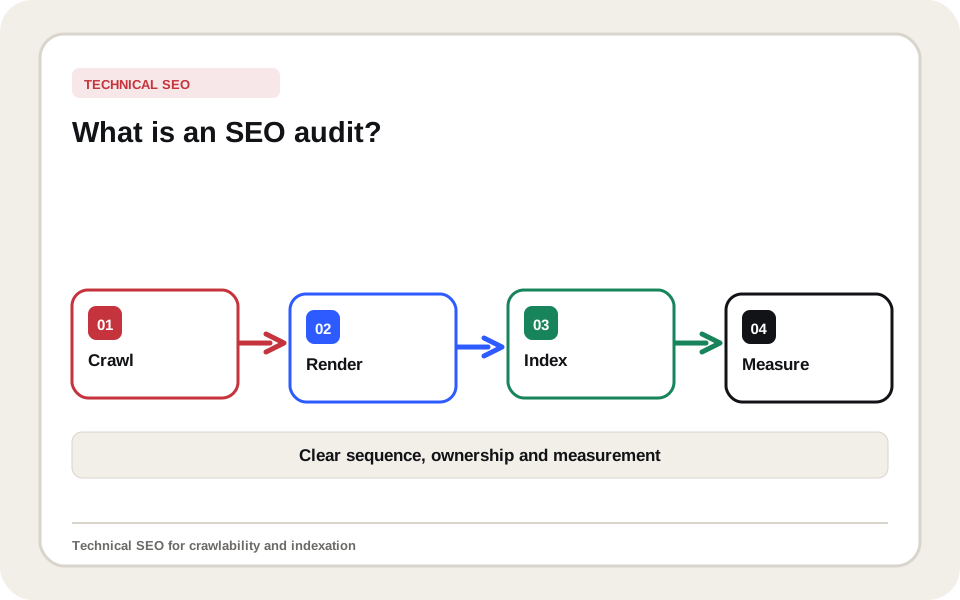
We combine tool data with manual review. Google Search Console shows indexation and search performance, and PageSpeed Insights combines available field data with a lab diagnosis for one URL. But the value sits in the interpretation: which errors actually cost you traffic, and which are cosmetic.
The most underestimated finding in an audit is rarely speed. It is indexation: pages accidentally set to noindex, or pointing elsewhere through the wrong canonical. We therefore start an investigation with index status, because there is more loss there than in a slow load time.
What does a usable audit report look like?
A usable report opens with the decisions the owner has to make. The evidence follows per finding: affected URLs, source, verification, priority and who executes it. The summary makes clear what is confirmed and which hypothesis still needs research. A general health score is not enough for that.
| Finding | Evidence | Action and owner | Check after execution |
|---|---|---|---|
| An important service page unintentionally returns noindex | HTML and URL inspection with a date | Administrator restores the intended instruction | Verify the public HTML; review index status again later |
| An old menu links through two redirects | Crawl with source URL and redirect chain | Developer points the link straight at the correct final URL | New crawl and a manual navigation test |
| A template loads an oversized hero image | Repeatable lab diagnosis and available field data | Developer adjusts format and loading behaviour | Comparable test and a visual check on mobile |
| A commercial page does not answer an essential decision question | Query and page data, customer questions and a content review | Editor adds a substantiated explanation or comparison | Content review; follow relevant queries and enquiries later |
These examples are illustrative and not client results. A restored noindex or link can be verified technically straight away, but additional indexation, traffic or revenue does not follow from it automatically.
How do we decide what gets fixed first?
We weigh the importance of the affected pages, the reliability of the evidence, the number of affected templates, the risk and the execution needed. An error blocking the primary service page can therefore outrank hundreds of warnings about unimportant archives.
- Blockage: a confirmed error prevents access, intended indexability or an essential conversion. Establish cause and a safe fix first.
- Structural improvement: a shared template or content pattern disrupts several important pages. Plan execution and test coverage together.
- Optimisation: a plausible improvement without an acute blockage. Prioritise on expected value and available capacity.
- Further research: insufficient evidence. Gather more data instead of presenting a far-reaching change as a certainty.
Per action we record an owner, a dependency and an acceptance criterion. Later search performance is a separate measurement point. That way a delivered technical fix is not confused with a promised ranking result.
What does an audit deliver?
A prioritised report with a summary, an evidence list, the URLs involved and an execution plan. Reassess the need for an audit at major changes, persistent problems or a website migration. An audit is the logical starting point of any technical SEO project.
When the audit touches several teams, markets or service areas, an SEO strategy converts the findings into goals, dependencies, owners, phases and measurement points. The audit describes the current situation; the strategy decides which desired change gets capacity first.
Which access and information are needed?
We start with business goals, main services and markets, known problems and recent changes. Read access to Search Console and analytics helps substantiate the diagnosis. For server logs, a staging environment or CMS settings we agree separately on what access is genuinely required. Never share an administrator password through a contact form.
A public crawl without account access can find useful signals, but cannot confirm full indexation history, revenue or lead quality. Missing sources and sampling limits are therefore stated in the report. On WordPress we also investigate which plugin, template or setting produces the output we found.
What falls outside the audit, and what happens next?
An audit is a diagnosis with recommendations. Implementation, new copy, development, a migration and ongoing monitoring are included only when agreed in advance. The review ends with a choice: execute internally, work alongside a developer, or start a defined follow-up project.
At delivery, check whether a colleague can trace the findings, whether important actions have an owner and whether success is testable. A list of warnings without a source, an affected URL or a next step is not yet a finished action plan.
What is the difference with a GEO audit?
An SEO audit focuses on indexation, technology, content, structure and organic performance. A GEO audit adds generative questions, brand mentions, source citations, entity clarity and a separate AI visibility measurement.
Keyword cannibalization is only actionable when overlapping URLs serve substantially the same intent and create an unwanted search outcome. Diagnose query-to-page data, page purpose and business impact before merging or redirecting content.
SEO-friendly URLs use a stable, crawlable and descriptive structure without treating the path as a keyword field. Review URL anatomy, parameters, international structures and migration decisions before changing established addresses.