
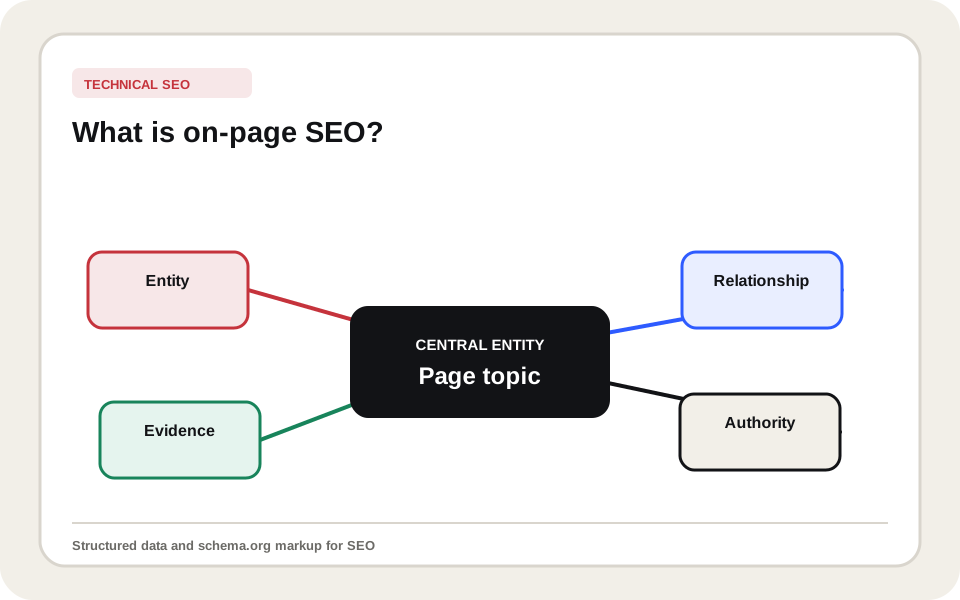
What does on-page SEO include?
On-page SEO consists of all content and structural signals on a page. These signals tell search engines what the main topic is, which sub-questions are answered and for which search intent the page is suitable.
Is on-site SEO the same as on-page SEO?
On-site SEO and on-page SEO are often used interchangeably. In practice, most searchers mean the same thing: improving the components on your own website so that Google and visitors understand your page better.
Strictly speaking, on-site SEO can also include broader site elements such as navigation, internal link structure, and template quality. On-page SEO focuses more on the individual page.
| Element | Role |
|---|---|
| Title tag | Main title in search results, usually around 50 to 60 characters |
| Meta description | Mainly influences the click from Google |
| H1 | Makes the main topic of the page clear |
| H2 and H3 headings | Organize sub-questions, definitions, steps and comparisons |
| Content | Answers the search intent completely and concretely |
| Internal links | Connect the page to relevant topics and services |
| Images and alt text | Clarify content and help with accessibility |
Which on-page SEO tasks are a priority?
Start with the components that directly determine whether a page is understood, clicked on and read. For a commercial page the order is usually this.
- Sharpen the search intent: information, comparison, local, service or purchase.
- Write a unique title and H1 around the real main topic.
- Start the intro with the answer, the decision aid or the commercial context.
- Add missing sub-questions about price, approach, timing, risk and evidence.
- Link internally to parent services and supporting articles.
- Check that the page isn't competing with another article for the same search intent.
How do you recognize a weak on-page page?
A weak page often gets impressions, but few clicks or no stable growth. The cause is usually not a single keyword, but a mismatch between title, content and search intent.
| Signal | What you adjust |
|---|---|
| Lots of impressions, few clicks | Sharpen title and meta description |
| Ranking remains around positions 8 to 20 | Expand content with missing sub-questions |
| Visitors quickly click back | Make the intro shorter and answer faster |
| Rank multiple pages for the same term | Separating search intent and correcting internal links |
Strong SEO copywriting starts from solid keyword research and a clear content strategy. You can further expand the internal context with internal link structure. Google describes the basics in the SEO Getting Started Guide.
Common mistake
The mistake we see most often is a page that wants to cover too many topics at once. Google then does not know what the page should rank for, and no topic is strong enough. A page should serve a primary search intent.
How do you make content machine readable?
Machine-readable content uses clear definitions, question-driven headlines, short answers, and logical entities. With structured data and schema.org you also make explicit what your page is about. This helps with rich results in Google and citations in AI answers.
What role do internal links play in on-page SEO?
Internal links connect individual pages into clear topic clusters. An SEO page becomes stronger when it links to keyword research, copywriting, technical SEO, and local SEO. The anchor text should describe what the visitor gets after the click.
When should you rewrite a page?
Rewrite a page when search intent has changed, when competitors are answering more fully, or when Search Console is showing many impressions without growth. Small optimizations are sufficient for titles and headings. If the angle is wrong, a complete rework will work faster.
In practice
A quick on-page profit often comes from pages that already rank just outside the top ten. A sharper title, a more direct intro and some missing H2 answers can improve click-through rate and position without adjusting the entire site.
An SEO keyword represents the topic and intent a page should address, while a search query is the exact wording used by a real searcher. Group close variants by intent before mapping them to a primary page.
Internal linking connects pages on the same website through crawlable, relevant routes. Review the definition, anchor-text guidance, architecture examples and audit checklist before changing links at scale.
Open Graph metadata defines a page-specific title, description, image and object URL for link previews. Keep those fields consistent with the visible page, canonical URL, language and structured entity data.
SEO-friendly URLs use a stable, crawlable and descriptive structure without treating the path as a keyword field. Review URL anatomy, parameters, international structures and migration decisions before changing established addresses.