
Updated on
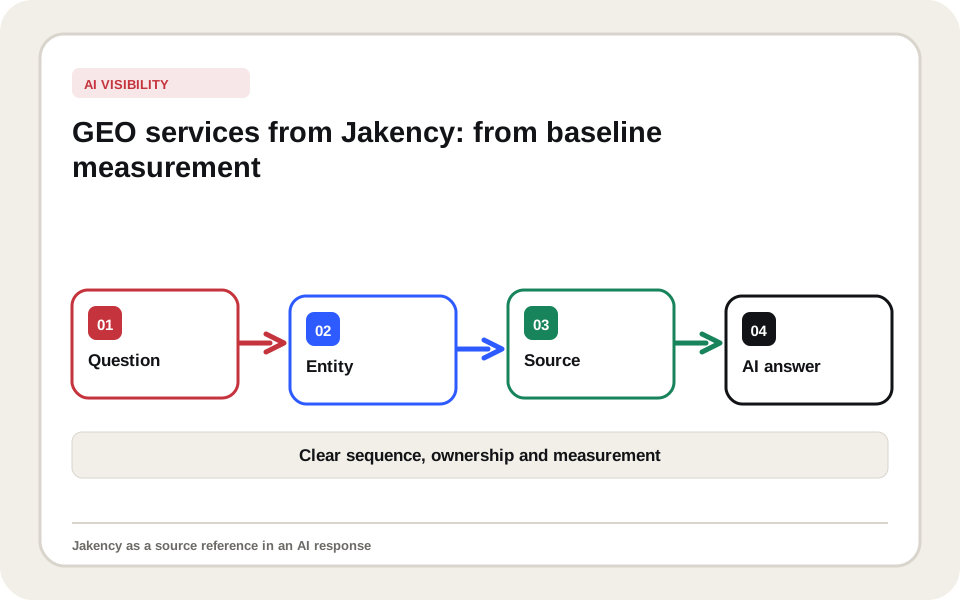
GEO builds on SEO. You therefore do not automatically need a new AI page or a large GEO project. Sometimes the biggest opportunity lies in an existing page that already ranks well, but doesn't have a directly citable answer, clear authorship, or reliable evidence. Every collaboration therefore starts with a baseline assessment and a choice of the questions, entities and source pages that are most commercially important.
Free | human-reviewed | no obligation
What are GEO services?
GEO services are defined activities that make a brand, person, service or product clearer, more reliable and more citable for generative search and answer engines.
The work can focus on baseline assessment, strategy, entities, content, structured data, authorship, external source consistency or measurement. The goal is not to manipulate an AI system, but to organize information so that systems can correctly find it, understand it, compare it, and quote it where relevant. The page What is GEO? explains the field; this page discusses the concrete implementation and deliverables.
What GEO services does Jakency offer?
Jakency combines diagnosis, implementation and follow-up in eight GEO service areas that can be deployed individually or as a process.
GEO audit and baseline assessment show where you are visible today
A GEO audit examines which questions your brand is listed for, which pages appear as sources, and where entities, evidence, or technical signals are missing.
- When necessary
- You don't know whether AI systems know your brand, describe it correctly or use it as a source.
- Activities
- Prompt set, brand and source control, entity review, content review, structured data, crawlability and competitive comparison.
- Delivery
- Baseline with question clusters, current mentions, citations, source pages, gaps and priorities.
- Metric
- A reproducible initial situation per question type and AI system.
GEO strategy determines which questions you want to appear as a source for
A GEO strategy connects commercial questions, target groups, entities, existing SEO pages, external sources and a fixed measurement method.
- When necessary
- Multiple services, target groups or AI channels are important and individual optimizations lack coherence.
- Activities
- Question clusters, entity map, source pages, channel priorities, evidence plan, internal links and measurement plan.
- Delivery
- Roadmap with priority questions, pages, activities, owners and measurement periods.
- Metric
- Each priority question is linked to a clear source page and evidence strategy.
Entity architecture makes brand, people and services recognizable
Entity optimization makes explicit who or what your organization is, what characteristics belong to the entity and how brand, people, services, locations, tools and cases are related.
- When necessary
- Name, expertise, services or company information are described differently on different pages and profiles.
- Activities
- Entity map, attributes, relationships, central profile pages, sameAs signals, internal links and source consistency.
- Delivery
- Fixed entity definitions, attribute matrix and implementation plan per page and profile.
- Metric
- Kernentiteiten en relaties zijn zichtbaar, consistent en technisch herbruikbaar.
Answer-first content makes passages instantly quotable
GEO content optimization rewrites existing pages so that definitions, comparisons, decision rules and key facts are early, clear and verifiable.
- When necessary
- Strong SEO pages are long or general, but don't provide short answers that AI systems can easily process.
- Activities
- Topic sentences, definitions, tables, FAQs, examples, limitations, evidence and publication dates.
- Delivery
- Publication-ready adjustments per existing URL or new content briefs.
- Metric
- Priority questions have an explicit answer, context, and supporting evidence.
Technical GEO and structured data improve machine readability
Technical GEO checks whether important information is in indexable HTML, crawlers have access and structured data matches the visible content.
- When necessary
- Important content is behind scripts, crawlers are blocked or schema and visible text contradict each other.
- Activities
- HTML accessibility, robots rules, canonicals, structured data, metadata, sitemaps, hreflang and internal links.
- Delivery
- Technical tickets, schema deployments, and post-publish auditing.
- Metric
- Key resource pages are accessible, interpretable, and technically consistent.
Authorship and evidence strengthen source trust
This service makes visible who is responsible for the content, what expertise is based on and which current cases, data or sources support the claims.
- When necessary
- Content contains strong statements, but little authorship, experience, source attribution or current information.
- Activities
- Person and Organization pages, author blocks, reviewed-by-processes, cases, sources, dates and claims control.
- Delivery
- Trust architecture with visible profiles, evidence blocks and fixed editorial rules.
- Metric
- Key claims are linked to a person, organization, source, date or case.
Channel optimization targets content to ChatGPT, Google and Perplexity
Channel optimization translates the same reliable source base into the technical and content requirements of specific generative systems.
- When necessary
- One AI channel is commercially or strategically more important than the others.
- Activities
- Crawler control, channel-specific source analysis, prompt testing, SERP and AI views, and priority page adjustments.
- Delivery
- Channel plan and optimizations for the chosen systems.
- Metric
- Mentions, citations and answer quality by fixed prompt and channel.
AI visibility measurement makes GEO periodically auditable
GEO measurement follows with a fixed prompt set or brand, pages and competitors are listed, cited and properly described.
- When necessary
- You perform GEO work, but cannot demonstrate whether visibility and resource usage changes.
- Activities
- Prompt library, channel testing, citations, answer share, factual correctness, AI referrals, and reporting.
- Delivery
- Baseline assessment, periodic dashboard and overview of changes and next actions.
- Metric
- Comparable measurements by prompt, system and period.
How do you choose which GEO service is needed first?
The first GEO service follows from the clearest problem in recognizability, citability, technology, evidence or measurement.
| Signal | First service | Why |
|---|---|---|
| You don't know if AI systems are calling you | GEO audit and baseline assessment | First create a reproducible initial situation. |
| You have many services or target groups | GEO strategy | Choose questions, entities, source pages, and priorities. |
| Your brand is described incorrectly or inconsistently | Entity architecture | Make definitions, attributes and external signals consistent. |
| Pages rank, but don't provide a direct answer | Quotable content | Make key passages answer-first, specific and auditable. |
| Content is difficult to reach for crawlers | Technical GEO | Check HTML, robots rules, canonicals and structured data. |
| Claims lack author, source or current case | Authorship and evidence | Link expertise and statements to verifiable evidence. |
| One AI channel is a priority | Channel optimization | Focus analysis and testing on that system. |
| Optimization takes place without a fixed measurement | AI visibility measurement | Work with the same prompts, systems and periods. |
What concrete deliverables do you get?
A GEO service is only clear when it is determined in advance which questions, entities, pages, systems and measurement periods are handled.
| Deliverable | What you receive |
|---|---|
| Baseline assessment | Prompt set, current mentions, citations, competitors and source pages. |
| Demand clusters | Definitions, comparisons, recommendations, local and commercial decision questions. |
| Entity folder | Brand, people, services, locations, products, cases and mutual relationships. |
| Page actions | Concrete rewrites, proof blocks, internal links and technical changes per URL. |
| Structured data | Schema that matches visible facts and uses fixed entity IDs. |
| Source consistency | Adjustments for website, profiles and relevant external sources. |
| Measurement plan | Fixed prompts, systems, settings, periods and KPIs. |
| Follow-up | New citations, lost citations, factual errors, and next priorities. |
How do you evaluate a GEO agency before signing?
Ask for verifiable work and a measurement method rather than guaranteed AI recommendations. A credible proposal connects a diagnosed problem to specific changes, responsibilities and review points.
- Scope: which existing SEO tasks are included and which work is additional?
- Baseline: which relevant, including non-branded, questions are tested in which systems and markets?
- Evidence: can you inspect raw answers, sources, failures and repeated tests, not just selected screenshots?
- Implementation: which pages, facts or external-source problems will change, and why?
- Ownership: who retains accounts, content, exports and measurement history after the engagement?
- Review: what is delivered during the contract and when do you decide to adjust or stop?
A list of agencies in a forum is not an independent ranking. Check commercial interests and ask case-study providers about their role, reporting period, limitations and evidence connecting work to outcomes. More citations, recommendations and qualified inquiries are different results. A useful proposal makes that distinction clear.
What is not automatically included?
The scope must explicitly state which content, technology, external publications and measurement frequency are included.
- Guaranteed mentions or source citations in an AI system
- Unlimited new pages, blogs or revision rounds
- Complete SEO rebuild when basic issues are out of scope
- Paid media, sponsored publications or paid external mentions
- Modification of all external profiles without access or permission
- Own tooling or API costs for large-scale monitoring
- Legal assessment of AI, privacy or compliance claims
- Guarantees about conversion and turnover
When do you choose a separate service, strategy, training or ongoing process?
The suitable form of collaboration depends on the size of the GEO demand and the implementation capacity within your organization.
| Form of collaboration | When is this appropriate? |
|---|---|
| Demarcated GEO service | One clear issue, such as an audit, entity restructuring or priority page optimization. |
| GEO strategy | Multiple services, demand clusters, teams or channels must be brought together in one plan. |
| GEO training | Your team wants to learn to apply the method, quality rules and measurement approach themselves. |
| Hybrid collaboration | Jakency carries out audits and specialist adjustments; the internal team processes content or profile updates. |
| Continuous GEO process | Questions, source pages, external signals and measurements must be structurally improved and monitored. |
A GEO strategy brings all choices together in one plan. The GEO training teaches your team to apply the method itself. This service hub remains focused on the work and concrete delivery.
How does a GEO process work at Jakency?
A GEO process follows a fixed cycle of baseline assessment, prioritization, source improvement, technical control and repeated measurement.
- Step 1Determine business goals, audiences, and priority AI questions.
- Step 2Measure current mentions, citations, competitors, and source pages.
- Step 3Map brand, people, services, locations, products, and evidence as entities.
- Step 4Review existing SEO pages for answer quality, evidence, and citability.
- Step 5Improve content, internal links, authorship and structured data.
- Step 6Check crawlability and channel-specific technical signals.
- Step 7Retest the same prompt set in the agreed systems.
- Step 8Report changes, factual errors, and new priorities.
How are GEO results measured?
GEO results are measured with fixed prompts and clear channel boundaries; classic Google data and external AI entries are not mixed up.
| Measurement area | What is recorded |
|---|---|
| Brand mention | Is the organization or person mentioned in a regular question? |
| Source citation | Is your own URL visibly used as a source? |
| Answer share | How often does the brand appear against selected competitors? |
| Factual correctness | Are services, expertise, location and other key facts displayed correctly? |
| Demand coverage | In how many priority questions does the brand or its own source appear? |
| Google generative signals | Separate signals within Google, with their own source and period. |
| External AI Referrals | Recognizable referral traffic from AI tools in analytics. |
| Commercial impact | Brand searches, assisted conversions, conversations and leads where reliably measurable. |
How do SEO and GEO work together?
SEO makes pages relevant, crawlable and discoverable; GEO makes the same information more explicit, reliable and usable for generated answers.
| Layer | Role |
|---|---|
| SEO basics | Search intent, technique, content quality, authority, internal links and organic performance. |
| GEO Expansion | Entities, direct answers, quotable facts, source consistency, authorship and AI measurement. |
| Joint result | A source that has a chance of being used in both traditional search results and in generative answers. |
When crawling, indexing, or content quality is weak, SEO recovery takes priority. GEO separated from a reliable SEO and branding foundation is usually inefficient. View the available SEO services when classic SEO components need to be repaired or implemented first.
Which case shows the GEO approach?
Ask Gustavo shows how scalable SEO, structured data and GEO come together in an existing AI platform.
Technology, entities, GEO and measurement
Ask Gustavo
Technical SEO, scalable page architecture, entity relationships, Google Search measurement and separate AI visibility measurement.
Check out the Ask Gustavo caseA GEO engagement does not buy placement in an AI answer. When paid conversational advertising is relevant, use a separate ChatGPT Ads pilot with its own media, conversion and revenue reporting.
The case explicitly distinguishes between Google Search performance, generative signals within Google, and external listings in systems such as ChatGPT and Perplexity.
How much do GEO services cost?
The costs depend on the number of entities, source pages, demand clusters, AI channels, content adjustments required and measurement frequency.
A one-off audit requires a different commitment than a continuous process with page optimization, external profile consistency and monthly prompt measurements. A concrete proposal will follow after defining the scope; we do not publish a fixed package price when the content varies greatly per organization.
When is GEO not the right first step?
GEO is not the right first step when the basic information, website or proposition is not yet sufficiently reliable or feasible.
- Important pages are not crawlable or indexable.
- The website does not contain any clear services, target group or evidence.
- Brand and company information has not yet been determined internally.
- There is no capacity to implement content or technical recommendations.
- The organization expects guaranteed AI listings or immediate high traffic.
- Any legal or compliance issue must first be assessed by a qualified specialist.
- There is hardly any demand or relevant information to serve as a source.