
Updated on
Users search by dish, ingredient, cuisine and location. The assistant links that question to restaurants and menus. This makes visibility dependent on a scalable page architecture and clear relationships between the entities on the platform.
What are the most important facts about Ask Gustavo?
Ask Gustavo is an existing AI platform for which Jakency takes care of the SEO and GEO, without claiming the construction or design of the product.
| Platform | Ask Gustavo |
|---|---|
| Project type | AI search assistant for restaurants and dishes |
| Role of Jakency | SEO, GEO, technical SEO, content architecture and measurement |
| Not performed by Jakency | Original construction and design of the platform |
| Public scale | 10,000+ menus in Flanders |
| Google Search period | April 27 to July 26, 2026 |
| Live platform | ask-gustavo.com |
What does Ask Gustavo do?
Ask Gustavo searches restaurant and menu information to turn natural food questions into relevant dishes and restaurants.
A visitor does not need to know in advance which restaurant is suitable. A question can start with a dish, ingredient, cuisine or place. The platform then connects that search intent with concrete restaurant and menu data.
What does Jakency provide within this project?
Jakency ensures the organic visibility of the existing platform in Google and works on the information base that generative systems can understand and quote.
- Technical SEO for crawlable and indexable page types
- Scalable architecture for locations, restaurants, kitchens, dishes and menus
- Content frames that help prevent thin and duplicate pages
- Structured data and consistent entity relationships
- Contextual internal links between related pages
- GEO for clear, quotable facts and answers
- Google Search Console measurements and separate AI visibility monitoring
Why does this platform require scalable SEO?
Thousands of location, restaurant and menu pages require fixed quality rules that continue to work even with further growth.
Each indexable page must have its own search intent, main entity and usable data set. Just changing a place or restaurant name in a repeating template is not enough. Unique data, direct answers, logical relationships and topicality determine whether a page has independent value.
How is the information architecture structured?
The architecture connects each page type to a clear main entity and to the next step that a user or search engine expects.
| Page type | Main content and relationships |
|---|---|
| Location page | Restaurants and menus in a city or region, linked to dishes and cuisines |
| Restaurant page | Restaurant, menu, location, contact, opening hours and related options |
| Menu and dish | Searchable topics with ingredients, categories and restaurants |
| Cuisine and category | Shared culinary theme that groups relevant dishes and restaurants |
| AI assistant | Link natural questions to the right dishes, locations and restaurants |
How does technical SEO help keep scale manageable?
Technical SEO determines which pages search engines are allowed to discover, index, and treat as preferred.
The approach includes crawlable URLs for regions, cities and restaurants, correct canonicals, indexation rules, sitemaps and control over filter, search and parameter URLs. Coverage problems, duplication and pages without impressions are also part of the periodic check. Learn how technical SEO and structured data support these machine-readable relationships.
How do content boxes prevent thin or duplicate pages?
A page only becomes valuable when it contains more than a swapped name in the same template.
- A unique main entity with a recognizable search intent
- Own restaurant, menu, dish or location data
- A direct answer to the question behind the page type
- Internal relationships with relevant parent and in-depth pages
- A process to identify outdated or incomplete information
What results does Google Search Console show?
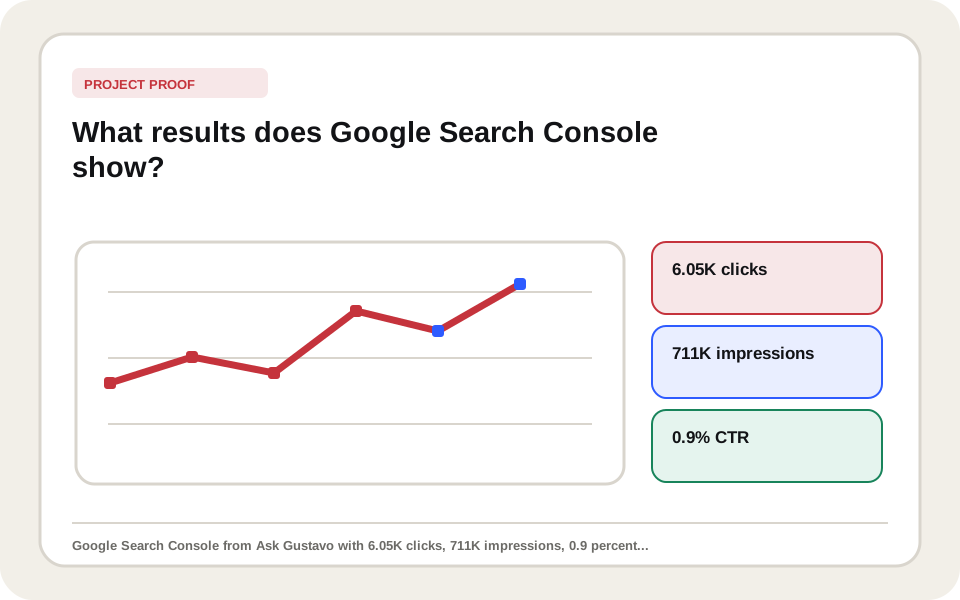
Over the three months from April 27 to July 26, 2026, Ask Gustavo generated 6.05K organic clicks and 711K impressions in Google Search, with an average rank of 8.4. The daily trend increased especially in June and July.
What do these Search Console numbers prove and don't prove?
The numbers prove demonstrable visibility and traffic from Google Search within the chosen period, but no growth rate or revenue result.
No comparison with the previous period has been provided. Therefore, we do not attribute the increasing daily trend to one change or solely to Jakency's work. The reporting also does not include a breakdown by page or query, conversions, leads, revenue, or a separate traffic quality assessment.
How should the average CTR of 0.9 percent be read?
In addition to a lot of visibility, the CTR of 0.9 percent also shows room to convert more impressions into clicks.
The average position of 8.4 is around the first results page, but averages hide big differences between searches and page types. Lower positions on page one, broad queries, SERP features, snippets, and different search intent can affect CTR. A reliable conclusion therefore requires a breakdown by query, page, device and country.
What does Search Console show about generative AI features?
A separate Search Console view for Generative AI features shows 4.86K impressions within the selected three-month period.
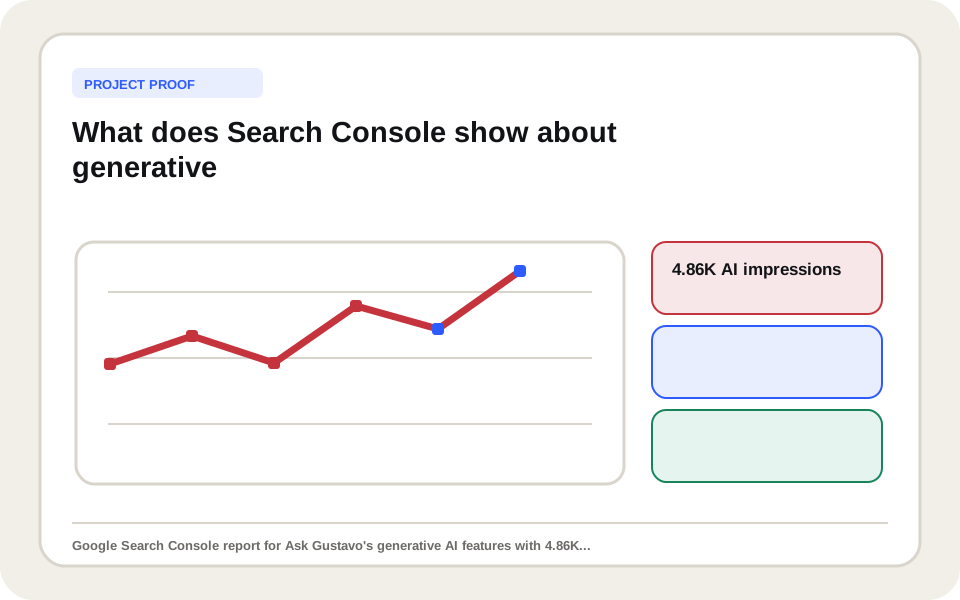
This is a Google signal. It does not prove that Ask Gustavo was listed or cited as a source in ChatGPT, Perplexity, Gemini or other third party answering engines.
Why is this both an SEO and a GEO project?
SEO makes the pages crawlable, indexable and relevant, while GEO makes the underlying entities and facts useful for generative answers.
| Discipline | Focus within Ask Gustavo |
|---|---|
| SEO | Crawling, indexation, search intent, internal links, structured data and organic positions |
| GEO | Entiteiten, attributen, directe antwoorden, bronconsistentie en citeerbare feiten |
| Overlap | Clear information about restaurants, locations, dishes, menus and the platform |
This combination joins search engine optimization and Generative Engine Optimization as two measurable parts of the same information architecture.
How is external AI visibility measured separately?
External AI visibility is measured with a fixed set of questions and monthly comparisons per answer engine.
- Set up fixed test questions per city, cuisine, dish and restaurant situation.
- Test branded and non-branded variants in the same systems and settings.
- Record citations, source citations, answer share, and factual correctness.
- Save prompts, answers, and measurement date for auditable comparison.
- Compare the same prompt set monthly and report trends, not isolated snapshots.
The method is further explained on the page about Measuring AI visibility.
What evidence is now available?
The case currently contains public platform evidence and Search Console data, with clear boundaries for results that have not yet been demonstrated.
| Evidence | Status and context |
|---|---|
| Existing public platform | Verifiable via the live website |
| 10,000+ menus | Public mention on the homepage |
| Location and restaurant pages | Publicly available platform structure |
| 6.05K clicks and 711K impressions | Google Search Console, April 27 to July 26, 2026 |
| Average position 8.4 | Google Search Console over the same period |
| 4.86K generative AI impressions | Separate Google Search Console view in three months |
| External AI entries | Still to be measured with a fixed prompt method |
| Conversion, leads and turnover | Not demonstrated with the data provided |
What can other scalable platforms learn from this case?
A large platform only becomes sustainably discoverable when technology, data, entities, pages and measurements are managed as one system.
- Determine which search intent and main entity are central for each page type.
- Only publish indexable pages that have demonstrable unique value.
- Connect locations, organizations, products and categories with consistent relationships.
- Separate Google Search results from external AI visibility.
- Don't report growth without a comparison period and don't report revenue without conversion data.
- Use fixed measuring moments so that trends remain verifiable later.