
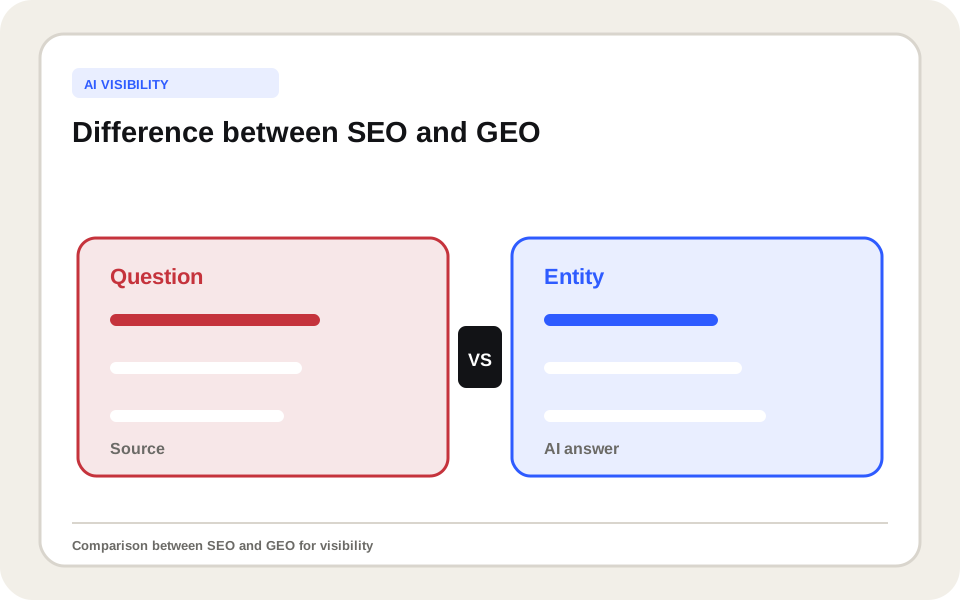
How do SEO and GEO differ in practice?
The difference is the search experience and the outcome being measured, not a requirement to maintain two versions of every page. A useful source can support both, but its performance in one system does not establish its performance in another.
| Question | SEO | GEO |
|---|---|---|
| What is the objective? | Relevant organic discovery and visits that support business goals | Accurate representation, recommendations or source citations in selected AI systems |
| What work overlaps? | Useful content, access, internal structure and trustworthy business information | The same foundation, checked against the questions and sources used in AI answers |
| What is measured? | Queries, impressions, clicks, landing-page outcomes and qualified enquiries | Recorded prompts, valid answers, mentions, cited URLs, accuracy and identifiable referrals |
| What is not established? | A ranking does not prove an AI citation | A citation does not prove a visit, sale or broad market share |
Do AI Overviews and AI Mode require a separate SEO system?
Google says its fundamental SEO practices remain relevant to AI Overviews and AI Mode. A supporting page must be indexed and eligible for a regular Search snippet; no special AI markup is required and inclusion is not guaranteed. This guidance concerns Google, not every external answer engine. See Google's AI features guidance.
For ChatGPT and Perplexity, check the relevant crawler documentation and observe each system separately. Do not assume that a top Google position is a universal admission requirement or that FAQ markup forces a citation.
Are AEO, GEO and AI SEO different deliverables?
These labels are used inconsistently. AEO usually refers to answer engine optimization, GEO to generative engine optimization, and AI SEO can describe either AI-assisted SEO work or optimization for AI search. Ask a provider to define the actual tasks and evidence instead of treating an acronym as a separate product.
Structured data can express supported entities and relationships. It does not make an unsupported claim trustworthy and is not a universal AI ranking guarantee. The visible source, its facts and technical accessibility still need to be checked.
What should GEO add if you already pay for SEO?
Ask which additional checks and deliverables are included. Content improvements and technical fixes may serve both goals; the same task should not be billed twice simply under a new name. Additional work can include a fixed prompt set, cited-source analysis, incorrect brand descriptions and separate tests across AI systems.
A service label, schema score or selected screenshot is not an outcome. Define the buyer questions, actual changes and repeatable checks before starting. Google's guidance explains the SEO overlap for its own AI search features; it does not establish identical sources or recommendations across external systems.
Should you move your SEO budget into GEO?
Not because of a trend post or a universal split such as 70/30. Maintain work that supports qualified demand and investigate AI visibility gaps through a bounded experiment. Record costs, duration, source changes and the criteria for continuing or stopping.
An AI citation without a click may support recognition, but it does not prove revenue. A click decline alone also does not prove that AI caused it. Review demand, positions, search-result presentation, conversion and commercial outcomes together.
How will your strategy change?
Start with the customer task and the existing source page. Resolve technical access problems, unclear services or missing evidence before multiplying content. Add system-specific checks only when they answer a real business question.
Use the same well-maintained page when it serves the same intent. When a genuinely different task needs its own explanation, validate that distinction with search-result and overlap checks. Read the GEO strategy guide for prioritization and AI visibility measurement for a repeatable reporting method.