
Published on
What is an SEO competitor analysis?
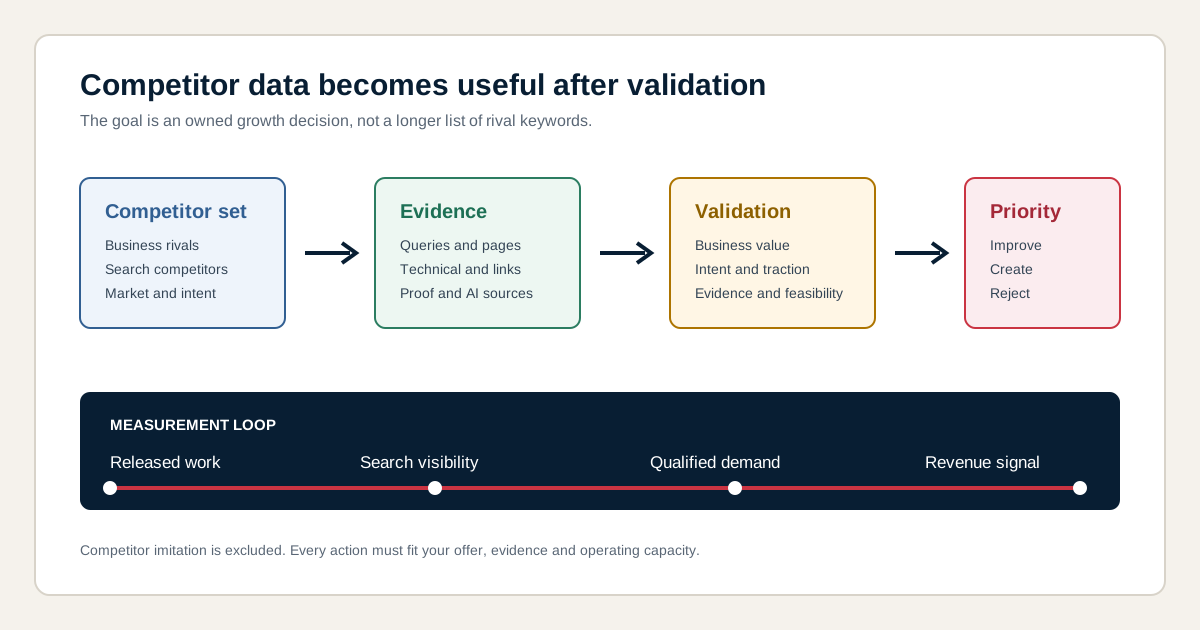
An SEO competitor analysis is a structured comparison between your website and the domains competing for search demand that matters to your business. It examines which queries and pages earn visibility, how information is organized, what technical and authority conditions support those pages and where your site has a credible opportunity to improve.
The output should not be a copied keyword list. It should state which existing page to improve, which new page or tool to create, which technical problem to fix, which evidence to develop and which apparent gaps to reject. This makes competitor analysis a decision input within an SEO strategy, not a substitute for strategy.
What do SEO competitor analysis services deliver?
SEO competitor analysis services deliver a validated competitor set, evidence base, opportunity model and prioritized roadmap. The exact scope depends on markets, website size, business goals and available first-party data.
| Output | What it contains | Decision supported |
|---|---|---|
| Competitor map | Business rivals, organic competitors, markets and intent groups | Who should be compared for each user task? |
| Visibility baseline | Queries, pages, positions, features and current traction | Where does each domain currently appear? |
| Gap inventory | Missing demand, weak pages, formats, links, proof and technical conditions | What could change? |
| Validation register | Business fit, intent, evidence, feasibility and exclusions | What deserves action? |
| Priority roadmap | Owners, dependencies, acceptance criteria and measurement | What happens first and who owns it? |
Who counts as an SEO competitor?
An SEO competitor is any domain that repeatedly competes for a search intent your organization wants to serve. That domain does not need to sell the same service or product.
A direct competitor may compete for customers but have weak organic visibility. A publisher, marketplace, directory, association, review site, government source or software company may dominate an informational search without being a direct commercial rival. The analysis therefore builds a competitor set per market and intent instead of using one fixed list for the entire website.
| Competitor type | Relationship | What to learn |
|---|---|---|
| Direct business competitor | Sells a comparable offer to a similar audience | Commercial positioning, service coverage and proof |
| Organic search competitor | Ranks for relevant queries | Intent ownership, page formats and topical coverage |
| Authority source | Defines or documents the subject | Entities, verifiable facts and source expectations |
| Aggregator or marketplace | Combines many options or data points | Scale, comparison utility and category structure |
| AI-cited source | Appears as a source in generative answers | Citation patterns, evidence and entity clarity |
Which areas should an SEO competitor analysis cover?
A complete analysis should cover demand, page ownership, information, technical delivery, internal links, external authority, proof and measurement. The depth of each workstream should follow the actual constraint.
- Demand: queries, clusters, intent, journey stage and market terminology.
- Pages: landing pages, hubs, supporting content, tools, templates and cannibalization.
- Information: consensus coverage, unique evidence, examples, freshness and unanswered questions.
- Technical: crawling, indexation, rendering, canonicals, performance and structured data.
- Architecture: navigation, contextual links, click paths and relative page emphasis.
- Authority: referring sources, linkable assets, mentions, authors and reputation evidence.
- AI visibility: brand mentions, citations, source ownership, entities and answer accuracy.
- Business outcome: qualified traffic, leads, revenue, margin and operational capacity.
How are keyword gaps analyzed?
Keyword gaps are analyzed by comparing relevant query portfolios and mapping them to the pages that currently own each intent. The goal is to discover unmet demand or weak ownership, not to create a page for every exported phrase.
Search volume, position and difficulty metrics are estimates from third-party databases. They help prioritize research but do not prove traffic or business value. Existing Google Search Console impressions can provide stronger evidence that your site already has traction for a query or related page. Similar wording, singular and plural forms and close synonyms are grouped when they represent the same user task.
Does every competitor gap need a new page?
No, most competitor gaps should first be tested against an existing page and its intended job. A new URL is justified only when the user needs a distinct outcome, evidence set and conversion path.
| Observed gap | Likely content unit | Validation question |
|---|---|---|
| Close synonym of an owned query | Sentence or terminology update | Is the search task actually different? |
| Important unanswered subquestion | Section on an existing page | Does the answer support the same page outcome? |
| Distinct service or audience need | Dedicated commercial page | Can the business deliver and prove the offer? |
| Complex repeatable task | Guide, template or functioning tool | Does utility matter more than more prose? |
| Irrelevant high-volume topic | No page | Would the visitor ever become a suitable customer? |
How is competitor content depth evaluated?
Competitor content depth is evaluated by separating required topic coverage from useful information gain. Word count alone is not a depth metric because a long page can repeat general statements without helping a user decide or act.
Jakency reviews central entities, attributes, subquestions, procedures, comparisons, examples, evidence, sources, visuals and the relationship between macro sections and micro answers. Repeated competitor claims establish a coverage floor. Competitor-only claims are treated as candidates that require verification. Original additions can include first-party data, calculations, decision matrices, scenarios, tools, expert judgment or a clearer synthesis.
How are technical SEO differences compared?
Technical differences are compared at page, template and system level. A competitor's faster page or cleaner index does not automatically reveal the cause, so the analysis records observable output and avoids unsupported conclusions about hidden systems.
- Status codes, canonical targets, robots directives and sitemap inclusion.
- Rendered content, crawlable links, pagination and faceted URL behavior.
- Template consistency across categories, products, services and locations.
- Core Web Vitals field data where available and representative lab diagnostics.
- Structured data that matches visible page content.
- Internal linking, click depth and orphan-page patterns.
A technical SEO audit focuses on your own website's technical health. Competitor analysis adds comparative context, but competitor implementation should never replace direct testing of your production output.
How are backlinks and authority compared?
Backlinks and authority are compared by examining relevant referring sources, linked assets, page context and repeatable relationship patterns. Raw link counts and proprietary authority scores are not treated as Google metrics.
Third-party backlink indexes discover different samples and can report different totals. Important sources should be opened and classified before they influence a roadmap. The useful question is not how to copy every competitor link. It is which evidence, research, utility, partnership or public contribution makes your organization a credible source worth citing. That work can connect to link building services and digital PR.
How does AI visibility change competitor analysis?
AI visibility adds prompt competitors, cited sources, entity relationships and answer accuracy to conventional search comparison. A domain can be weak in blue-link rankings yet appear in ChatGPT, Perplexity or another answer system through a cited third-party source.
Jakency separates Google Search data from external AI observations. A repeatable prompt set records system, date, market, language, answer, mention, recommendation, citation and factual accuracy. The analysis then distinguishes an owned source gap from an external reputation or entity gap. GEO services provide the deeper source architecture and measurement work when AI visibility is a primary objective.
Which data sources and tools are used?
The toolset combines first-party performance data, live search results and independent third-party databases. Each source has a defined purpose and limitation.
| Source | Useful for | Limitation |
|---|---|---|
| Google Search Console | Your queries, pages, clicks, impressions and search trends | Only your verified property and not every anonymized query |
| Analytics and CRM | Behavior, leads, sales and revenue contribution | Depends on tracking, consent and data quality |
| Live SERPs | Current result types, intent and visible competitors | Can vary by location, device, language and time |
| SEO platforms | Estimated keywords, pages, links and historical comparisons | Modeled databases with incomplete coverage |
| Website crawler | Technical output and internal architecture | Configuration affects what the crawl sees |
| AI prompt tests | Mentions, citations and answer competitors | Answers are variable and require repeated observation |
How are competitor opportunities prioritized?
Competitor opportunities are prioritized by business value, intent fit, evidence confidence, execution feasibility and realistic effort. Jakency uses these factors as an internal decision model, not as search engine ranking factors.
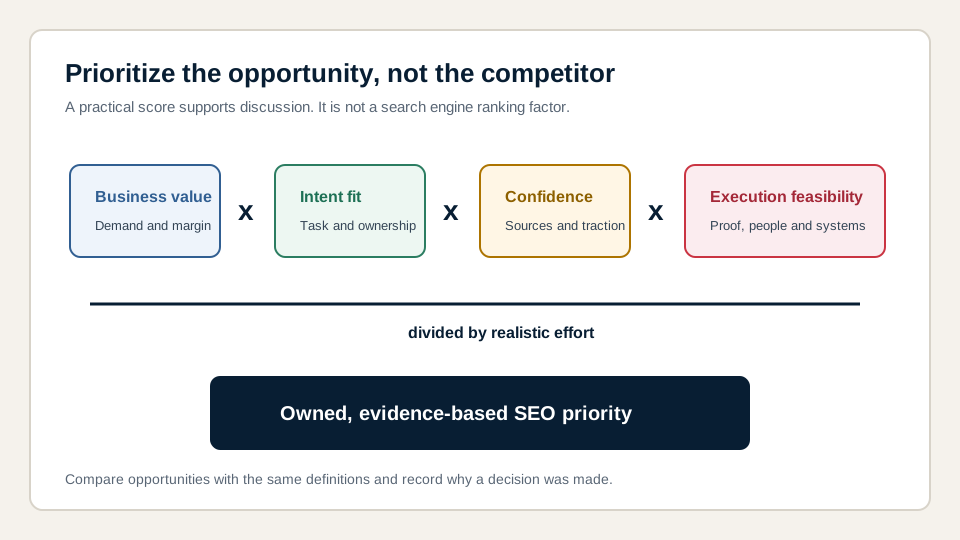
The score starts a discussion rather than ending it. A lower-volume service page with proven conversion value can deserve priority over a high-volume informational topic. An attractive gap may be rejected when the organization lacks the offer, expertise, evidence or maintenance capacity required to own it responsibly.
What does the SEO competitor analysis process look like?
The process moves from commercial scope to validated action and later measurement. Each phase records assumptions and evidence so the roadmap remains auditable.
- Scope: define business goals, offers, audiences, markets, languages and conversion actions.
- Baseline: document current search traction, page ownership, technical conditions and business outcomes.
- Competitor set: identify direct rivals and organic competitors per intent and market.
- Evidence collection: compare queries, pages, content, technology, links, proof and AI citations.
- Gap classification: separate missing demand, weak ownership, technical blockers and authority needs.
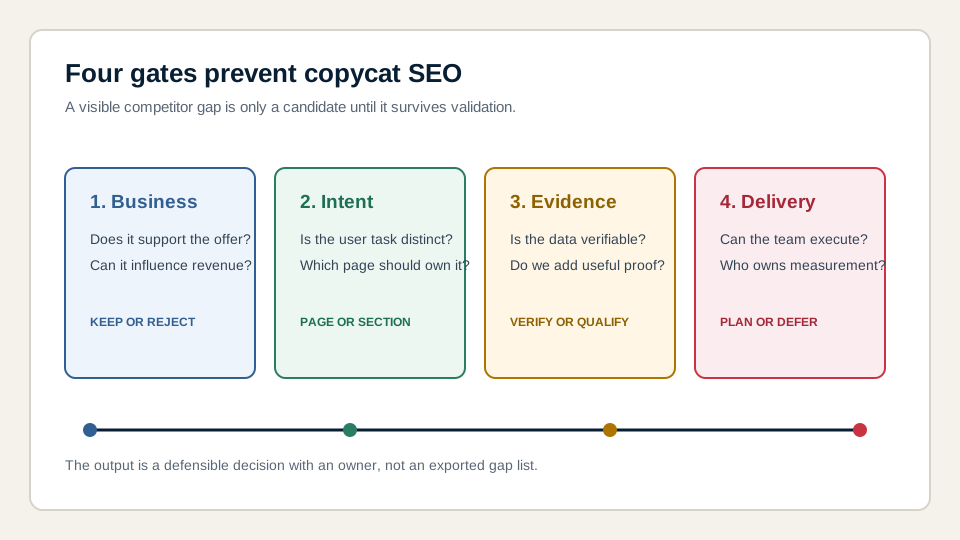
- Validation: apply business, intent, evidence and delivery gates.
- Prioritization: assign action, owner, dependency, acceptance criteria and measurement.
- Review: measure comparable periods and refresh assumptions when the market changes.
What should a competitor analysis report contain?
A competitor analysis report should contain decisions and traceable evidence, not only dashboard screenshots. The reader should understand what to do, why it matters, which source supports it and what remains uncertain.
- Management summary with the main constraint and highest-value opportunity.
- Defined competitor set by market, language and intent.
- Data periods, filters, tool limitations and confidence notes.
- Keyword and page ownership map with cannibalization controls.
- Content, technical, internal link, authority and proof findings.
- Opportunities rejected and the reason for rejection.
- Prioritized roadmap with owners, dependencies and acceptance criteria.
- Measurement plan for visibility, qualified demand and business outcomes.
How does analysis differ across countries?
International competitor analysis treats each country and language as a separate evidence environment. Search terminology, result composition, competitor strength, local sources, currency, regulation and conversion expectations can change across markets.
Jakency works from Belgium with organizations targeting Belgium, the Netherlands, the United States, the United Kingdom and other markets. A domain that dominates the United States may have little authority or relevance in Belgium. The international SEO service connects market selection, architecture, localization and rollout when the opportunity spans several countries.
How is success measured after the analysis?
Success is measured by separating completed work from later search and business effects. An analysis is delivered when the evidence, decisions and roadmap are usable. Organic impact is evaluated after approved actions are released.
| Measurement layer | Examples | Question |
|---|---|---|
| Delivery | Validated opportunities, owners and accepted roadmap | Was the decision system completed? |
| Implementation | Pages improved, created or consolidated and technical releases | Was approved work released correctly? |
| Search visibility | Relevant impressions, clicks, CTR, positions and indexation | Is qualified organic visibility changing? |
| AI visibility | Mentions, citations, accuracy and answer share | Are selected systems using the intended sources? |
| Business outcome | Qualified leads, pipeline, revenue or margin | Does the work support commercial goals? |
How much do SEO competitor analysis services cost?
Cost depends on the number of markets, languages, domains, query clusters, URLs, technical templates, datasets, backlink depth, AI systems and required workshops. A focused analysis of one commercial cluster requires a different scope from a multi-country website and full authority review.
A reliable proposal defines the questions, competitor-selection method, data sources, markets, deliverables, review rounds, implementation ownership and exclusions. It should also distinguish analysis from content production, development, outreach and recurring rank or AI monitoring. Broader budget context is available in the SEO pricing guide.
How should an SEO competitor analysis provider be selected?
Select a provider that explains how competitor evidence becomes a business-specific decision. A large export or proprietary score is not enough.
| Selection question | Strong answer | Warning sign |
|---|---|---|
| How are competitors selected? | By market, intent and repeated live visibility | Only a client-provided list of business rivals |
| How are estimates handled? | Labeled, cross-checked and separated from first-party data | Tool estimates presented as exact traffic or revenue |
| How are gaps validated? | Business fit, intent, evidence, traction and feasibility | Every missing keyword becomes a new page |
| What is the deliverable? | Decisions, owners, dependencies and acceptance criteria | Spreadsheets without a recommended action |
| How is copying avoided? | Original proof, utility, expertise and information gain | Rewriting the highest-ranking competitor |
Why use Jakency for SEO competitor analysis?
Jakency combines founder-led SEO research with technical implementation, content architecture, GEO and business measurement. You work directly with Jan Kenis, founder of Jakency and SEO, GEO and AI consultant.
The analysis is designed to produce fewer, stronger decisions. Existing traction is improved before unnecessary URLs are created. Competitor claims are not copied, and third-party estimates are not presented as first-party facts. The projects and case studies show where Jakency's actual role and available evidence can be verified.
Which sources support this competitor analysis framework?
The measurement guidance was checked on August 26, 2026 against official Google documentation. Live competitor pages and Semrush data confirmed current search intent and recurring coverage. They were not used as proof of a ranking factor or as copy templates. Jakency's four validation gates and priority model are internal operating frameworks.
- Google Search Central: using Search Console and Google Analytics data for SEO
- Google Search Console: Performance report use cases
- Google Search Console: advanced filters and comparisons
- Google Search Console: Links report and its limitations
- Google Search Central: creating helpful, reliable, people-first content