
Updated on
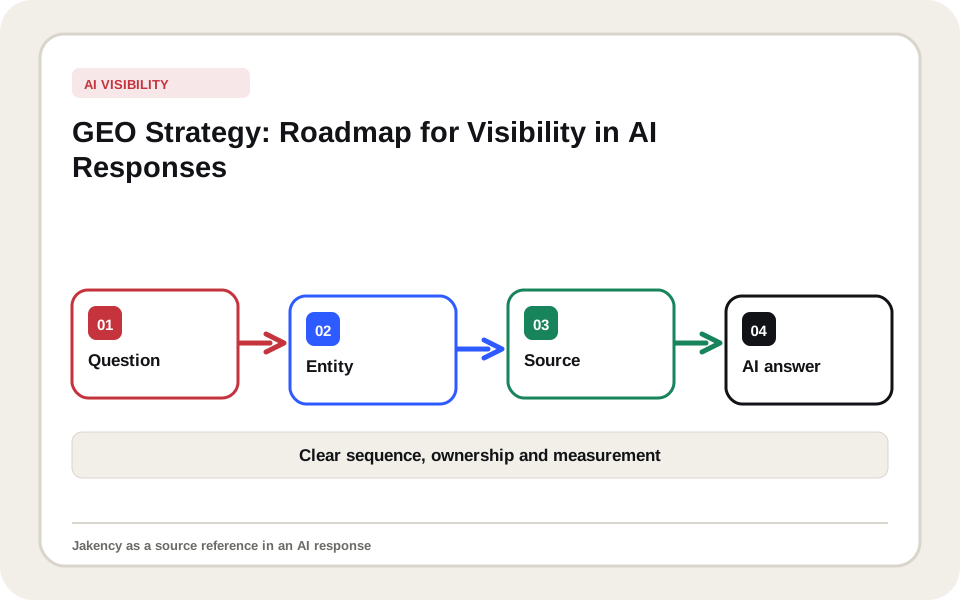
The strategy builds on SEO, but adds an extra layer of decision-making. You not only choose which page should rank, but also which source an AI system should be able to understand, summarize and cite. Then you record who manages the information, how external signals remain consistent and how visibility is measured periodically.
Free | human-reviewed | no obligation
What is a GEO strategy?
A GEO strategy is a plan for your organization's resource position in generative search and response engines.
The plan connects business goals, customer questions, entities, source pages, evidence, technical readability, external profiles and a fixed measurement method. The outcome is not a list of general optimization tips, but a roadmap that indicates which information needs to be improved first, who is responsible and how the effect will be assessed later. The GEO main page explains the basics; this page discusses the strategic choices and implementation sequence.
When do you need a GEO strategy?
A GEO strategy is especially necessary when multiple questions, services, target groups, locations or AI channels are important and individual page optimizations do not provide sufficient coherence.
- Your organization has multiple services, product lines or experts.
- Customers use AI systems for comparison, selection or advice.
- Competitors are mentioned or quoted more often than your own brand.
- Sterke SEO-pagina's leveren nog weinig herkenbare bronpositie in AI-antwoorden.
- Company, service and personal information differs between website and external profiles.
- Multiple teams publish content without common entity and evidence rules.
- You want to translate audit results into an executable roadmap.
- You want to measure GEO structurally instead of testing prompts incidentally.
If there is no reliable initial situation yet, start with a GEO audit. The strategy uses the baseline assessment to determine goals, priorities and dependencies.
Which strategic choices do you make first?
A GEO strategy starts with choices about value and focus, not with rewriting all the pages.
| Strategic choice | Main question |
|---|---|
| Business purpose | Which expertise, service, market or product should become more visible? |
| Target group | Who asks the question and at what stage of the customer journey? |
| Question type | Is it a definition, comparison, recommendation, local choice or commercial decision? |
| Entity | Which organization, person, service, location, product or case should be recognizable? |
| Source page | Which URL contains the best direct answer and evidence? |
| Channel | Which AI systems are really relevant for this target group? |
| Metric | What mention, citation, correctness or commercial indicator is being tracked? |
What components does a GEO strategy contain?
A complete GEO strategy contains nine interrelated components that together determine the desired source position and execution order.
Item 1
Goals and scope
Markets, target groups, services, systems and time horizon.
Part 2
Baseline assessment
Current mentions, citations, competitors, source pages and technical blocks.
Part 3
Demand architecture
Priority demand clusters by customer phase and commercial importance.
Item 4
Entity architecture
Core entities, attributes, relationships and fixed source pages.
Part 5
Source architecture
Main sources, supporting pages, evidence and internal links.
Part 6
Content and evidence rules
Direct answers, sources, authorship, dates, cases and limitations.
Item 7
Technology and external signals
HTML, structured data, crawlers, canonicals, profiles and brand consistency.
Part 8
Roadmap and governance
Phases, owners, dependencies, review process and capacity.
Part 9
Measurement and maintenance
Fixed prompts, KPIs, reporting frequency and updates.
How do you determine the right demand clusters?
Question clusters are selected based on commercial value, expertise, provability and the likelihood that generative systems will provide a composite answer.
| Demand cluster | Example |
|---|---|
| Definition | What is a concept or service? |
| Problem and solution | How do I solve a problem and which approach is suitable? |
| Comparison | What is the difference between solution A and B? |
| Selection | Which companies, specialists or tools suit a situation? |
| Local choice | Who helps with a service in a certain region? |
| Costs and conditions | What does the service cost and what factors determine the price? |
| Risk and evidence | What should I pay attention to and how do I check quality? |
| Brand and person | What does the organization do and what does an expert specialize in? |
The strategy does not include every conceivable prompt. She selects the questions to which the organization can provide a credible, distinctive and verifiable answer.
How do forum questions become part of a GEO strategy?
Use discussions to understand context: who is deciding, which constraints matter and what evidence is missing? Turn each useful question into a research item, not immediately into another article.
- Source: thread URL, access date, original language and possible commercial interests.
- Context: audience, service, market, decision stage and explicit constraints.
- Evidence status: observed question, unverified claim, official documentation or a first-party result.
- Page owner: existing guide, service, comparison or genuinely separate task.
- Measurement question: which answer, source and accurate brand description should a later test examine?
A US discussion does not establish demand in the UK, Belgium or the Netherlands. Validate market and language separately. Questions about price, risk, implementation and alternatives are possible query expansions. Do not label a generated list as an AI system's observed query fan-out without reliable logs.
Do not manufacture reviews or independent-looking rankings to repeat a brand name. Correct demonstrated source errors and contribute useful evidence. A sound strategy must also allow the decision that a topic is irrelevant or lacks sufficient support to publish.
How do you prioritize questions and pages?
Priorities follow from a combination of business value, existing traction, strength of evidence, competitive pressure and feasibility.
| Priority factor | Assessment |
|---|---|
| Commercial value | How close is the question to an important decision or request? |
| Relevance | Does the question demonstrably fit with expertise, service or market? |
| Existing traction | Does a page already have impressions, rankings, links or brand awareness? |
| Evidence strength | Are cases, data, sources, authors and current examples available? |
| Competitive pressure | Which alternatives are mentioned more often today and why? |
| Technical feasibility | Can the source page be published, crawled and maintained correctly? |
| Maintenance burden | How often do facts, prices, supply or regulations change? |
How do you build an entity architecture?
The entity architecture determines which core entities the organization wants to recognize and which page is the official source for each entity.
| Entity | Strategic attributes |
|---|---|
| Organization | Company name, positioning, location, services, founder, contact and external profiles. |
| Person | Name, role, expertise, organization, authorship, cases and professional profiles. |
| Service | Problem, target group, activities, deliverables, work area and evidence. |
| Product or tool | Function, creator, target group, properties, documentation and cases. |
| Place | Location, working area and relationship with local services. |
| Case | Initial situation, role, activities, period, data source, results and limitations. |
Each core entity preferably has one central page, consistent naming, visible attributes, relevant external profiles and internal relationships to services, evidence and supporting content. The pages about Jakency and Jan Kenis show how Organization and Person are linked as fixed sources.
What is a source architecture?
A source architecture determines which page provides the primary answer and which supporting pages add context, evidence, and follow-up information.
| Source layer | Function |
|---|---|
| Primary source page | The best URL for one main question or entity. |
| Supporting explanation | Expands concepts, processes, equations and exceptions. |
| Evidence page | Cases, data, methodology, reviews or other verifiable substantiation. |
| Personal and organizational resource | Confirms author, expertise, organization and responsibility. |
| External source | Supports facts or brand consistency beyond your own website. |
| Measurement page or dashboard | Explains method, period and results of follow-up. |
The strategy prevents multiple pages from trying to deliver the same answer. Internal links connect the primary source with evidence and depth, so visitors and systems can follow the relationship without guesswork.
Which content rules belong in the strategy?
GEO content rules make answers direct, specific, and verifiable without turning every page into an artificial FAQ.
- Each main section begins with a sentence that directly answers the question.
- Definitions, equations and decision rules are in visible HTML.
- Claims are linked to source, author, date, methodology or case.
- Tables and lists are used when they improve comparison or extraction.
- Restrictions and exceptions are stated to avoid overclaiming.
- Authorship and update process are visible on expertise and decision pages.
- Internal links connect main entity, service, evidence and follow-up question.
- New pages are only created for an independent question or source function.
Which technical choices belong in the strategy?
Technical GEO ensures that important source pages are accessible, interpretable and consistent for search engines and relevant crawlers.
- Indexable server-rendered or trusted HTML content.
- Correct robot rules and crawler access according to company policy.
- Canonicals, redirects, hreflang and XML sitemaps.
- Structured data that corresponds to visible facts.
- Fixed entity IDs for Organization, Person, Service and other core entities.
- Breadcrumbs and contextual internal links.
- Control filters, search results and parameter URLs.
- Version and topicality management for rapidly changing facts.
When classic SEO issues block the source position, the roadmap first contains SEO work. The technical entity layer is further elaborated via structured data.
How do you choose the right AI channels?
Channel choice follows from target group, market and type of demand; not every system deserves the same effort.
| Channel | Strategic relevance |
|---|---|
| ChatGPT | Broad advice, comparison and work questions and visible web resources where available. |
| Perplexity | Source citations, research and direct comparison of sources. |
| Google AI Overviews and AI Mode | Generative answers and classic search results for the same search query. |
| Gemini | Target groups that work strongly in the Google ecosystem. |
| Copilot | Business and Microsoft-oriented target groups. |
The same source base can support multiple systems, but the strategy takes into account differences in crawler behavior, source rendering, personalization, and measurability.
What does the GEO roadmap look like?
The roadmap divides the strategy into six phases so that blockages and core resources are resolved first before the organization scales broadly.
- Phase 1BaselineAudit, prompt set, competitors, entities, source pages and technical blocks.
- Phase 2FoundationOrganization and Person resources, service definitions, authorship, structured data and internal left.
- Phase 3Priority questionsOptimization of existing strong pages and necessary new ones source pages.
- Phase 4Evidence and external signalsCases, data, methodology, relevant profiles and source consistency.
- Phase 5Channel optimizationTests and adjustments for the selected AI systems.
- Phase 6Measurement and IterationRepeated Prompts, Citations, Correctness, SEO Data and Next priorities.
Who is responsible for implementation?
A GEO strategy only works when ownership for facts, content, technology, evidence and measurement is established in advance.
| Role | Responsibility |
|---|---|
| Management or owner | Goals, positioning, priorities and endorsement of core claims. |
| Subject matter expert | Factual accuracy, methodology, exceptions and evidence. |
| Marketing or content | Pages, authorship, internal links and external profiles. |
| Development of IT | HTML, crawlability, structured data, templates and technical tickets. |
| Legal or compliance | Control of regulated or high-risk claims where necessary. |
| Jakency | Audit, strategy, prioritization, specialist implementation, quality control and measurement according to scope. |
What governance does GEO keep consistent?
GEO governance prevents key facts, authorship and source pages from growing apart again after the first optimization.
- One owner per core entity and primary source page.
- Fixed definitions for services, products, target group and work area.
- Review moment for new claims, figures, certifications or regulations.
- Update policy for prices, hours, features and other changeable facts.
- Version control of prompt set, measurement settings and reports.
- Process for incorrect AI responses and inconsistent external profiles.
- Quarterly review of priorities and available evidence.
Teams that want to apply these quality rules themselves can link the strategy to a GEO training.
How do you measure whether the GEO strategy is working?
The strategy does not measure one universal GEO score, but a fixed set of indicators per question, system and period.
| KPI | What is recorded |
|---|---|
| Brand mention | Is the organization or person mentioned in a regular prompt? |
| Source citation | Is your own or desired external source visibly used? |
| Answer share | How often does the brand appear against selected competitors? |
| Factual correctness | Are services, expertise, location, prices or other key facts correct? |
| Demand coverage | How many priority demand clusters does the organization appear in? |
| Source diversity | Which own and external sources support visibility? |
| Google generative signals | Separate data within Google, where available. |
| SEO traction | Impressions, clicks, positions and pages for the same topics. |
| Commercial signals | Merkzoekopdrachten, AI-referrals, assistconversies en gekwalificeerde gesprekken. |
The practical registration method is Measure AI visibility. Google Search data, Google generative signals, and external AI mentions remain separate layers of measurement.
How often is the strategy updated?
The strategy is updated when goals, offerings, resources, systems, or metrics change.
| Moment | Control |
|---|---|
| Monthly | Prompts, mentions, citations, factual errors, and major source changes. |
| Quarterly | Priorities, competitors, new questions, evidence and roadmap. |
| In case of major change | Website migration, rebranding, new service, new location, important case or regulation. |
| Annually | Complete recalibration of goals, markets, entity architecture and channel choice. |
What does a GEO strategy deliver in concrete terms?
The strategy provides a decision-making framework and roadmap with which content, technology, expertise and measurement work in the same direction.
| Deliverable | Content |
|---|---|
| Strategic summary | Goals, target group, scope, current situation and desired source position. |
| Demand architecture | Priority questions per customer phase, market and service. |
| Entity folder | Core entities, attributes, relationships and official source pages. |
| Source architecture | Primary sources, supporting pages, evidence and internal links. |
| Channel selection | Priority AI systems and channel-specific concerns. |
| Roadmap | Phases, actions, dependencies, owners and timing. |
| Content and evidence rules | Quality criteria for answers, claims, authorship and timeliness. |
| Technical plan | Crawlability, structured data, templates and entity IDs. |
| Measurement plan | Prompts, KPIs, systems, frequency and reporting. |
What is not automatically included?
The strategy determines what needs to be done; the quotation clearly states which implementation and external costs are or are not included.
- Complete rewrite and publication of all pages.
- Implementation of all technical tickets and schedule adjustments.
- Ongoing monthly monitoring and reporting.
- Modification of external profiles without access or permission.
- Paid media, digital PR, paid publications or monitoring tools.
- Translation, international localization and multilingual content production.
- Legal or compliance assessment of regulated claims.
- Guarantee on citations, rankings, leads or turnover.
What is the difference between strategy, audit, services and training?
Each GEO page has its own function in the route from diagnosis to implementation and follow-up.
| Part | Main question |
|---|---|
| GEO audit | Where are we today and which blockages are visible? |
| GEO strategy | Which source position do we want to build and in what order? |
| GEO Services | What specific activities are carried out? |
| GEO training | How does the internal team learn to apply the method themselves? |
| Measure AI visibility | How do we track mentions, citations and correctness periodically? |
For which organizations is a GEO strategy suitable?
A GEO strategy is especially suitable for organizations with sufficient expertise, source material and implementation capacity to structurally build visibility.
- B2B companies with complex services and longer decision processes.
- Software and technology companies with products that require explanation and comparison.
- Lokale specialisten die bij aanbevelings- en regiovragen zichtbaar willen zijn.
- Expertise companies with multiple authors, services and knowledge content.
- Platforms and directories with many interconnected entities.
- Organizations where source trust, timeliness and evidence are important.
The Ask Gustavo case shows how scalable SEO, entity relationships, GEO and separate measurement layers come together on an existing platform.
When is a GEO strategy not the right first step?
A GEO strategy is less useful when the information base, SEO technology or implementation capacity is not yet sufficiently stable.
- The website is not crawlable or important pages are not indexed.
- The proposition, target group or service names are still unclear internally.
- There are no subject experts, authors or supporting documents available.
- The organization just wants a quick entry in one AI system.
- There is no owner for content, technology or current affairs management.
- A legal, reputational or compliance issue must be resolved first.