
Updated on
Perplexity searches the web, compiles an answer, and displays numbered references to original sources. For companies, visibility therefore consists of several steps: the page must be accessible, relevant selected, correctly incorporated into the answer and, if necessary, visibly cited.
Channel Analysis | source optimization | periodic measurement
What is Perplexity?
Perplexity is an AI search engine that brings together web information into an instant answer with numbered citations and links to original sources.
The system can use different search modes and models. The concrete source selection and wording may therefore differ per question, mode, date, language and available web information. A single test does not provide a structural picture of your visibility.
What types of visibility should you distinguish?
Branding, source citation, and referral are different metrics and should not be reported as the same result.
| Visibility type | What it means | How to check it |
|---|---|---|
| Brand mention | The brand or person is mentioned, without a necessary link to your own site. | Check the visible answer text. |
| Source citation | A URL appears as a numbered or otherwise visible source in the response. | Open and register the quoted URL. |
| Own source citation | The quoted URL belongs to your own website. | Compare domain and canonical landing page. |
| External support source | Another website supports a fact or statement about the brand. | Check source, claim and factual accuracy. |
| Referral | A user clicks through from Perplexity and the visit is recognizable. | Measure in analytics or server data. |
How does citation work in Perplexity?
Perplexity uses web sources to support answers and displays numbered citations on web searches that allow users to open the original page.
A citation can support a specific claim, sub-topic or broader context. Therefore, do not assume that every single sentence is guaranteed to be linked one-to-one to one source. Always check which page is actually behind a reference and which part of the answer supports that source.
What crawler does Perplexity use for search results?
PerplexityBot is the official automatic crawler that can discover, index and link websites in Perplexity search results.
Perplexity notes that this crawler is not used to collect foundation model training content. To appear in Perplexity search results, you can allow PerplexityBot in robots.txt and prevent firewall or CDN rules from blocking the official crawler.
Which robots.txt line do you use for PerplexityBot?
Explicitly allow PerplexityBot when public website content may be available in Perplexity search results.
User-agent: PerplexityBot
Allow: /
Perplexity notes that changes to crawler settings may take up to approximately 24 hours for the systems to reflect them. A robots rule does not guarantee a crawl, inclusion, citation, or ranking.
What is Perplexity User?
Perplexity-User is a fetcher that can visit a page after a concrete user action in Perplexity.
It is not a regular automatic index crawler and is not used to collect content for foundation model training, according to Perplexity. Because the fetch was requested by a user, Perplexity-User typically ignores robots.txt. Anyone who wants to technically restrict access should therefore also review server, CDN and WAF rules.
What is the difference between PerplexityBot and Perplexity-User?
PerplexityBot automatically discovers content for search results, while Perplexity-User retrieves a page in response to a specific user query.
| Property | PerplexityBot | Perplexity User |
|---|---|---|
| Function | Automatic discovery, indexing and linking of websites. | Retrieve page after a user action. |
| robots.txt | Respects robots.txt. | Typically ignores robots.txt in a user-triggered fetch. |
| Foundation Model Training | According to Perplexity not used for this purpose. | According to Perplexity not used for this purpose. |
| Official IP list | perplexitybot.json | perplexity-user.json |
| Main control | robots.txt, user agent, source IP and logs. | User agent, source IP, logs and technical access rules. |
Should you allow Perplexity in your firewall?
Yes, when a Web Application Firewall or bot protection blocks legitimate requests and your public content is allowed to be accessible to Perplexity.
Perplexity recommends basing a WAF rule on the combination of the user agent and the officially published IP ranges. Simply relying on the name in the user agent is insufficient because that value can be impersonated.
- Use the current JSON endpoints from Perplexity as a source for the IP ranges.
- Link the correct IP list to PerplexityBot or Perplexity-User.
- Check if rate limits, bot management or challenge pages are blocking access.
- Give an allow rule sufficient priority compared to general blocks.
- Update IP sets periodically, as addresses can change.
A technical SEO analysis should also check rendering, canonicals, status codes, sitemaps and internal reachability.
How do you check if the crawler has access?
Check server, CDN and WAF logs and verify both the user agent and source IP.
- Search logs for requests from PerplexityBot and Perplexity-User.
- Compare the source IP to the correct official JSON endpoint.
- Check status code, redirect chain and final canonical URL.
- See if a challenge, login, consent layer or JavaScript dependency is blocking content.
- Test key source pages using the same WAF and CDN configuration as production.
- Recheck the logs after a robot or firewall change.
What helps a page to be useful as a resource?
A useful source page provides a specific answer, makes claims verifiable and clearly shows who is responsible for the content.
| Source attribute | Practical interpretation | To be avoided |
|---|---|---|
| Instant answer | Answer the main question at the beginning of the relevant section. | Long introduction without answer. |
| Verifiable claims | Mention period, source, method, conditions and limitations. | Absolute marketing claims without evidence. |
| Clear authorship | Show writer, expertise, organization and update date. | Anonymous or unverifiable expertise. |
| Own worth | Add cases, data, research, experience or primary information. | A generic summary of other pages. |
| Readable HTML | Place core information visibly and accessible on the page. | Important facts only in images or widgets. |
| Current affairs | Update mutable facts when content changes. | A new date without a meaningful update. |
These are practical quality principles for strong web resources. Perplexity does not publish a complete list of website ranking factors that can guarantee inclusion or citation.
Does content need to be written specifically for Perplexity?
No. First and foremost, write a useful, public source for the real reader.
A channel-specific check is useful. Check whether PerplexityBot can reach the page, whether the main question is answered directly, whether the primary entity is clear and whether important claims can be verified. Avoid unnatural keyword variations or thin pages created only for one prompt.
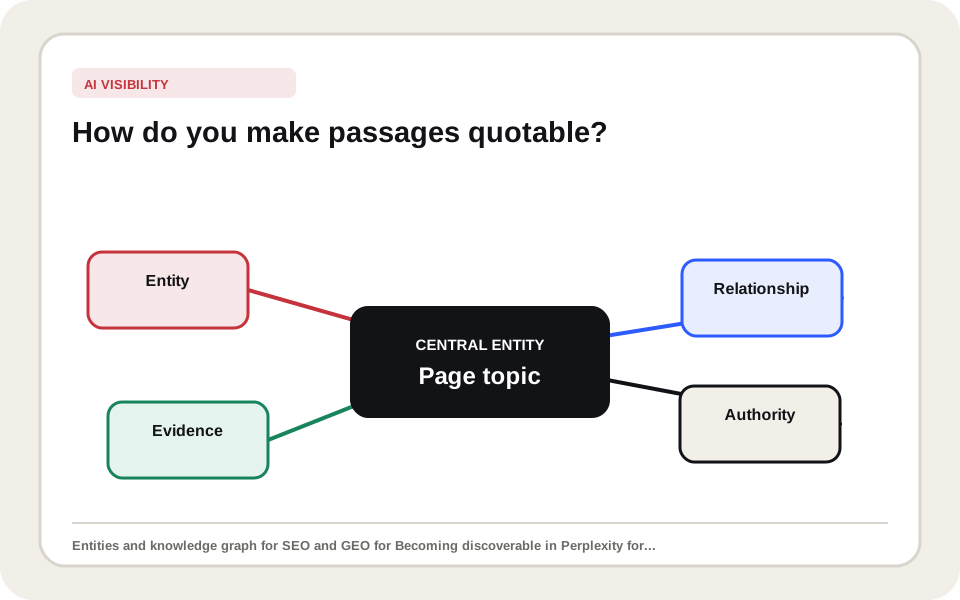
How do you make passages quotable?
A quotable passage contains an independently understandable answer with sufficient context and a clear boundary to the claim.
- Start with the answer and then add explanations.
- Mention the subject or entity explicitly instead of just this or that.
- Use concrete concepts, periods and units.
- List conditions and exceptions in the same section.
- Link figures to measurement period, source and methodology.
- Use tables when comparing multiple options or features.
- Avoid marketing language that cannot be objectively verified.
- Don't put important information solely in images or widgets.
What role do entities and source architecture play?
A clear entity and source architecture makes visible which page contains the official information about an organization, person, service, location, product or case.
| Entity or source | Primary page | Supporting evidence |
|---|---|---|
| Organization | Company, location, contact, services and founder. | External profiles and consistent business data. |
| Person | Name, role, expertise, employer and publications. | Author blocks, articles, cases and professional profiles. |
| Service | Target group, activities, deliverables and scope. | Cases, FAQ, prices or price factors and related expertise. |
| Product or platform | Function, features, availability and official information. | Documentation, data, use cases and comparisons. |
| Case | Role, context, approach, evidence and measurement period. | Public project information and reliable performance data. |
Use internal links to connect primary sources, supporting explanations, and evidence without any ambiguity. On Jakency link About Jakency, the profile of Jan Kenis and the projects and cases the same organizational and personal data with visible evidence.
Is structured data required for Perplexity?
No. Perplexity does not mention structured data in the official crawler and product documentation as an admission requirement or ranking factor for source selection.
Schema.org-markup can help to model the same Organization, Person, Service and other facts technically consistently. The visible HTML content remains leading. Don't put important claims exclusively in JSON-LD and don't make up Perplexity-specific schema types.
Do you need an llms.txt file?
No. Perplexity does not document llms.txt as a requirement for inclusion or citation of public websites.
A llms.txt file can be maintained as an experimental addition, but does not replace robots.txt, reachable HTML, clear navigation, canonicals, or strong source pages.
Do you have to constantly publish new content?
No. Current events are especially important when facts, prices, positions, people or rules actually change.
Update a page when the content requires it and make the measurement moment visible. Don't publish artificial changes just to show a new date. Perplexity emphasizes fresh web information as a product feature, but does not document a fixed freshness ranking factor for website owners.
How do you measure visibility in Perplexity?
Measure Perplexity separately with a fixed prompt set and record the brand mention, recommendation, citations, competitors, message and factual correctness per answer.
| Measuring field | What you capture |
|---|---|
| Prompt and category | Exact question, target group, customer phase and commercial value. |
| Fashion and model | Available search mode and model chosen where relevant. |
| Brand mention | Whether and what the brand, person, service or product is called. |
| Recommendation | Whether the entity is presented as an appropriate choice and for what reason. |
| Own citation | Which URL of your own website is visibly used. |
| External citations | What other sources support the answer and brand image. |
| Competitors | What alternatives appear and what sources support them. |
| Correctness | Whether key facts are complete, correct and up to date. |
| Referral | Recognizable visit, landing page, behavior and conversion. |
| Measurement context | Date, language, location, account context and relevant settings. |
The full method is at Measure AI visibility. A GEO audit first records the initial situation. A GEO strategy then determines which demand clusters, channels, and source pages are prioritized.
Does a source citation prove that Perplexity generates traffic?
No. A source citation enables click-through, but traffic must be determined separately in analytics or server data.
- Track recognizable referral visits from Perplexity.
- Check landing page and corresponding answer theme.
- Measure engagement, follow-up and conversion beyond sessions.
- Please note that visits may be classified differently or incompletely.
- Report no-click brand mentions separately from referral traffic.
Do not make causal growth claims in analytics when only a citation or a few referrals are visible. Compare longer periods and record changes made in an action log.
What is the difference between ChatGPT Search and Google AI?
Perplexity, ChatGPT Search, and Google generative functions use web resources, but differ in crawler management, interface, resource representation, and measurability.
| Channel | Technical access | Source view | Primary measurement |
|---|---|---|---|
| Perplexity | PerplexityBot and Perplexity-User with official IP ranges. | Numbered citations and links for web answers. | Fixed prompts, citations, correctness and referrals. |
| ChatGPT Search | OAI-SearchBot for search discovery, separate from GPTBot. | Inline citations and a source overview where Search is active. | Fixed prompts, citations and recognizable referral traffic. |
| Google AI Overviews and AI Mode | Indexing and suitability for a regular Search snippet. | Supporting links in Generative Search functions. | Search Console reporting where available. |
What work can Jakency carry out?
Jakency can analyze and improve technical access, source pages, entities and the measurement method around Perplexity.
| Work area | Possible activities |
|---|---|
| Technical crawler analysis | robots.txt, user agents, official IP ranges, logs, CDN, WAF and status codes. |
| Source analysis | Which own, external and competitor sources are used for priority questions. |
| Content optimization | Instant answers, claim checking, context, tables, authorship and current events. |
| Entity architecture | Organization, Person, Service, Product and Case relationships. |
| Technical SEO | HTML, canonicals, internal links, sitemaps and consistent structured data. |
| Perplexity measurement | Fixed prompts, citations, correctness, competitors and referral checking. |
| Action plan | Page, finding, proposed change, owner, impact and measurement moment. |
View all GEO services or learn to perform the analysis internally via the GEO training.
What do you receive with a Perplexity analysis?
A Perplexity analysis provides a verifiable baseline assessment and a prioritized action plan.
| Deliverable | Content |
|---|---|
| Technical accessibility check | PerplexityBot, Perplexity-User, IP Verification and WAF Findings. |
| Prompt set | Priority questions per target group, service, market and customer phase. |
| Source matrix | Own sources, competitor sources, external sources and missing source positions. |
| Page analysis | Concrete content and technical improvements per priority URL. |
| Entity and evidence control | Missing attributes, relationships, authorship, sources and cases. |
| Baseline assessment | Mentions, citations, correctness and competition per prompt. |
| Action plan | Priorities, dependencies, owners and next measurement date. |
What is not automatically included?
The analysis determines what needs to be improved, while the quotation states which implementation and external costs are included in the scope.
- Guarantee of inclusion, mention, recommendation or source citation.
- Complete rewrite and publication of all examined pages.
- Implementation of all technical, server and WAF adjustments.
- Continuous monitoring of all prompts, languages, markets and models.
- Modification of external websites or profiles without access or permission.
- Paid publications, digital PR, advertising or monitoring tools.
- Conversion, revenue or causal attribution without reliable data.
What does optimization for Perplexity cost?
The price depends on the number of prompts, pages, entities, markets, technical systems and desired measurement periods.
| Price factor | Why it determines the scope |
|---|---|
| Technical complexity | robots.txt, WAF, CDN, server logs and multiple domains or subdomains. |
| Number of source pages | More pages require more content and technical control. |
| Number of demand clusters | Definitions, comparisons, recommendations, local and commercial prompts. |
| Entities and evidence | People, services, locations, products, cases and external profiles. |
| Languages and markets | Each language or region requires its own source and prompt control. |
| Execution | Analysis, publication-ready rewrite and technical implementation vary in scope. |
| Measurement | One-off baseline assessment, remeasurement or periodic reporting. |
A detailed proposal follows after an initial conversation. A fixed package price without knowledge of the technical environment, question set and desired source pages would not be very reliable.
When is Perplexity optimization not the right first step?
Channel-specific optimization is less useful when the general information and SEO basis is not yet sufficiently reliable.
- Important pages are not public, crawlable or indexable.
- The organization has no clear services, entities or primary source pages.
- Claims lack authorship, evidence or current source information.
- There is no capacity to implement content or technical recommendations.
- The target group hardly uses Perplexity and other channels are demonstrably more important.
- The goal is only one positive citation without structural source quality.
What official Perplexity sources support this page?
Technical statements about crawlers, IP ranges, robots.txt and user-triggered fetches are based on current Perplexity documentation. The content optimization and measurement recommendations are practical advice from Jakency and are not presented as official or guaranteed Perplexity ranking factors.