
Published on
What does keyword cannibalization mean?
Keyword cannibalization means that multiple URLs from one site overlap so closely in query target, search intent and page purpose that the site gets an undesirable search result. One URL may replace another in the results, a less suitable page may attract the impressions, or separate pages may each remain too incomplete to perform as one strong resource.
The term is SEO industry language, not a separate Google penalty. The central entity is the search need. The relevant relationships are: a query expresses that need, a page promises to satisfy it, Google selects a result, and the visitor completes or abandons the intended task. A reliable diagnosis evaluates that full chain instead of counting how often a phrase appears across the website.
Is ranking multiple pages for one keyword always cannibalization?
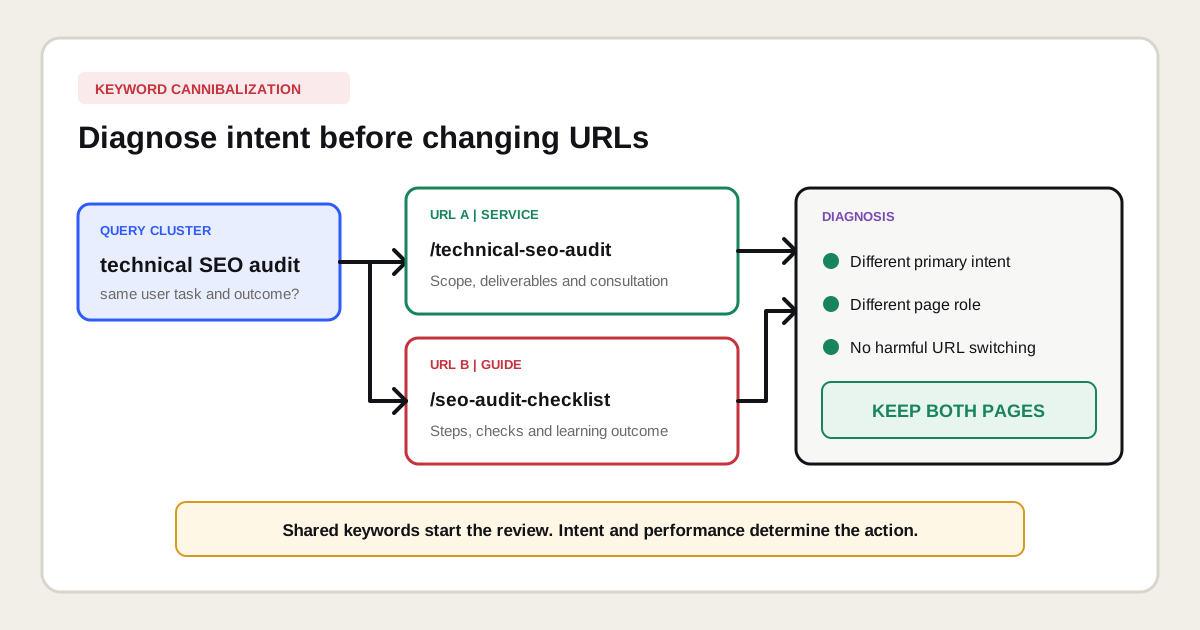
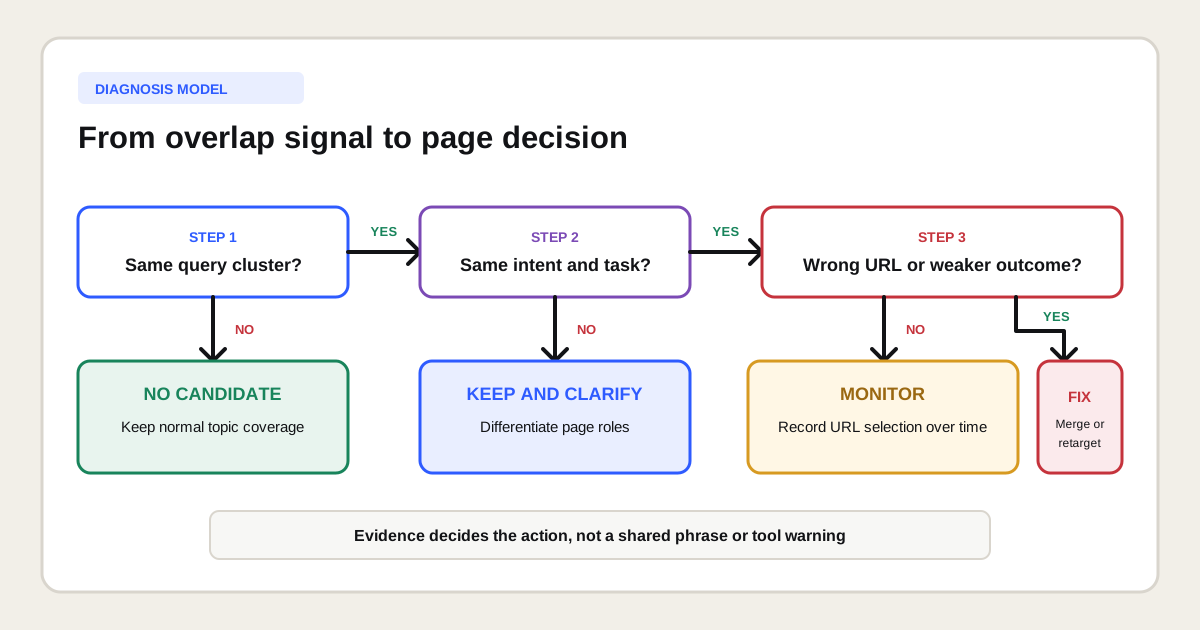
Ranking multiple pages for one keyword is not automatically cannibalization. Search queries can be broad or ambiguous, and one website may have several useful resources that answer different parts of the need. The overlap becomes actionable only when the pages target the same intent and the resulting URL selection or performance is worse than the intended setup.
| Observed pattern | Likely interpretation | Action |
|---|---|---|
| A category and a specific product both appear | Different levels of the same topic may help the searcher. | Keep when each page serves a distinct task. |
| A service page and an educational guide rank | Commercial and informational intent may coexist. | Clarify each role and monitor query segments. |
| Two near-identical guides alternate weekly | Purpose and intent probably overlap. | Assess consolidation. |
| The homepage ranks instead of a complete service page | Internal signals or page targeting may be unclear. | Strengthen the preferred page and architecture. |
| Several language URLs rank in the wrong market | Localization, canonical or hreflang signals may conflict. | Audit multilingual signals first. |
Start by understanding search intent and the difference between an SEO keyword and an actual query. A page can rank for many close keyword variants without competing with itself. Intent, page role and business outcome are the deciding attributes.
How is keyword cannibalization different from duplicate content?
Keyword cannibalization is a performance and intent problem, while duplicate content is a similarity condition between documents or URL variants. The two can occur together, but neither one automatically proves the other.
| Concept | Primary question | Typical evidence |
|---|---|---|
| Keyword cannibalization | Do multiple pages serve the same intent in a harmful way? | URL switching, wrong landing page, split performance or conversions. |
| Duplicate content | Are the documents identical or substantially similar? | Matching page content, parameters, print pages or protocol variants. |
| Canonicalization | Which URL should represent a duplicate set? | Canonical tags, redirects, sitemap inclusion and Google-selected canonical. |
| Topic overlap | Do pages mention related entities within distinct purposes? | Shared vocabulary but different questions, audiences or next steps. |
Google describes canonicalization as selecting the representative URL from a set of duplicate pages. Its canonicalization documentationexplains that redirects, rel="canonical" and sitemap inclusion are signals with different strength. The separate canonical tag guidecovers how those signals should agree.
Which signals indicate a real cannibalization problem?
A real cannibalization problem is supported by several signals occurring together. The strongest cases combine high intent overlap with unstable or unsuitable URL selection and a meaningful performance or conversion cost.
| Signal | What to inspect | Strength |
|---|---|---|
| Same intent and page purpose | Audience, question, answer format and next action | Required context |
| Wrong URL receives most impressions | Query-to-page mapping and conversion path | Strong |
| Ranking URL repeatedly switches | Daily or weekly landing-page history | Strong when demand is stable |
| Clicks fall while impressions move between URLs | Comparable query and page trends | Strong |
| Both URLs have weak, partial coverage | Content completeness and supporting evidence | Moderate |
| Both pages use one keyword | Words in titles, headings and copy | Weak by itself |
A site: search shows several pages | Rough index discovery only | Weak and non-comprehensive |
Do not call every ranking fluctuation cannibalization. Search results vary by location, device, date and result composition. Compare like with like, review a query cluster rather than one phrase and verify whether the supposedly wrong URL actually leads to a worse user or business outcome.
How do you find keyword cannibalization in Google Search Console?
Find potential cannibalization in Google Search Console by filtering the Performance report to a query and then reviewing which pages received impressions for it. Compare URLs across time, but account for Search Console aggregation, anonymized queries and data truncation.
- Open Search Console, choose the correct property and open Performance, then Search results.
- Select clicks, impressions, CTR and average position for a meaningful comparison period.
- Open the Queries tab and choose a relevant non-branded query.
- With that query applied as a filter, open the Pages tab.
- Record every URL with material impressions and identify its page type and intended task.
- Compare the current period with a comparable previous period to detect URL replacement.
- Repeat the check for close query variants that express the same intent.
- Link the landing pages to analytics or CRM outcomes before deciding which URL should lead.
Google's Search Console Performance use casesexplicitly describe selecting a query and opening the Pages tab to see which URLs Google showed. Its data documentation also explains that most performance data is assigned to a page's canonical URL. The Google Search Console guideexplains the wider limits of clicks, impressions, CTR and average position.
How do you audit cannibalization across a large website?
Audit a large website by joining query-to-page data with a page inventory and an explicit keyword map. Search Console provides first-party Google performance, a crawler identifies indexable pages and internal signals, and a rank tracker can show which URL occupied a tracked result over time.
| Dataset | Useful fields | What it cannot prove alone |
|---|---|---|
| Search Console | Query, page, date, country, device, clicks and impressions | The exact intent or conversion value of every query |
| Site crawl | Status, canonical, title, H1, internal links and indexability | Which queries Google actually shows |
| Rank tracking | Tracked query, date, URL and result position | Complete demand outside the tracked keyword set |
| Analytics and CRM | Landing page, engagement, lead quality and revenue | Exact organic query attribution for most sessions |
| Content inventory | Owner, page role, target cluster and update status | Live search performance without joined data |
Build candidate groups where two or more indexable URLs receive impressions for the same query cluster. Review those groups manually or with a documented scoring system. Automated similarity can prioritize work, but it cannot reliably decide whether a category, guide, comparison and service page should coexist.
How should you score the severity of a cannibalization case?
Score severity with four dimensions: intent overlap, URL instability, preference mismatch and business impact. A simple score keeps teams from merging pages merely because an SEO tool displayed a warning.
| Dimension | 0 points | 1 point | 2 points |
|---|---|---|---|
| Intent overlap | Distinct tasks | Partly overlapping | Same task and audience |
| URL instability | Stable preferred URL | Occasional second URL | Frequent switching |
| Preference mismatch | Right page leads | Mixed result | Wrong page consistently leads |
| Business impact | No meaningful loss | Possible CTR or journey cost | Clear traffic, lead or revenue cost |
Treat totals from zero to two as monitoring candidates, three to five as review priorities and six to eight as strong action candidates. This is a practical triage model, not a Google score. Keep the underlying evidence next to every point so another reviewer can reproduce the conclusion.
Which keyword cannibalization fix should you choose?
Choose the fix from the relationship between the pages. Merge and redirect true substitutes, retarget distinct pages with blurred roles, strengthen the intended primary page when the architecture is weak, and keep pages unchanged when they already satisfy separate needs.
| Situation | Preferred action | Required follow-up |
|---|---|---|
| Two complete pages serve the same intent | Merge into the strongest appropriate URL | 301 redirect and update links |
| One weak page duplicates a strong page | Remove and redirect the weak URL | Preserve unique useful details |
| Pages should serve different intents | Retarget titles, headings, copy and next steps | Rebuild internal anchor context |
| URL variants contain near-identical content | Consolidate with canonicalization or redirects | Align sitemap and internal links |
| A valuable page is accidentally indexable | Review whether noindex matches its purpose | Keep it accessible when users need it |
| Pages serve distinct tasks without harm | Keep both | Document their keyword map |
How do you merge and redirect competing pages safely?
Merge competing pages safely by selecting the URL that best matches the enduring intent, combining unique useful material and redirecting each retired URL directly to that close replacement. The destination should be a complete page, not automatically the homepage.
- Export each page's queries, backlinks, conversions, content and internal links.
- Choose the destination by intent fit, maintainability, history and business role.
- Map unique sections, examples, proof and questions worth preserving.
- Rewrite one coherent page instead of pasting two articles together.
- Publish the combined resource and add a direct permanent redirect from the retired URL.
- Update internal links, navigation, canonicals, hreflang and XML sitemaps.
- Inspect both URLs and monitor query-to-page performance after recrawling.
The 301 redirect guide explains how to prevent chains, irrelevant destinations and stale internal references. Keep an implementation log with the old URL, new URL, reason, deployment date and baseline metrics.
When should you retarget pages instead of merging them?
Retarget pages instead of merging when each page can serve a distinct user task with enough substance to justify its own URL. Clarify the audience, intent, promise, entity focus and next action across the title, H1, introduction, supporting sections and internal anchors.
For example, an SEO audit service page should explain scope, deliverables, evidence and how to engage the provider. A guide about performing an SEO audit should teach the procedure. Both may mention technical checks and Search Console, but their primary relationships differ: one connects buyer to service, while the other connects practitioner to method.
When do canonical tags or noindex make sense?
Canonical tags make sense for duplicate or near-duplicate URLs that must remain accessible, while noindex makes sense only when a page should not appear in search at all. Neither instruction should be used as a shortcut for an unresolved content strategy.
Do not point a canonical from a genuinely distinct article to another page merely to force a ranking preference. Do not add noindex to a useful page without checking its traffic, links, role and user need. If a removed page has a close successor, a direct permanent redirect is usually clearer than leaving the old URL available but excluded.
Which attempted fixes usually fail?
Failed fixes usually manipulate one signal without resolving why the pages overlap. Titles, canonicals and internal links cannot give two indistinguishable pages durable, separate roles.
- Deleting a page before preserving its unique value, links and conversion data.
- Redirecting every overlapping URL to the homepage or an unrelated category.
- Using
noindexon the preferred page or across a whole template without review. - Adding a canonical between pages that are not duplicates or close substitutes.
- Removing the target keyword from useful copy while the page purpose remains unchanged.
- Changing only the title tag and leaving the same answer, audience and call to action.
- Using internal
nofollowto hide unclear information architecture. - Assuming one rank-tracker warning proves lost performance.
How does cannibalization occur on ecommerce and marketplace websites?
Ecommerce cannibalization often occurs where categories, subcategories, filtered listings, products and buying guides target the same broad demand without a documented hierarchy. The correct solution depends on whether each URL represents a useful selectable set, a specific item, a comparison or an educational decision aid.
Keep valuable category and product pages when they satisfy different specificity. Control faceted URL variants through crawl, canonical and indexation rules. Give buying guides a clear educational role and link them contextually to the relevant category. Do not merge a product detail page into a category simply because both rank for a product family term.
How does cannibalization occur on service and local websites?
Service and local websites create cannibalization when the homepage, main service page and several location pages repeat the same generic offer without enough regional or task-specific value. Search engines and visitors then receive several interchangeable landing pages.
A location page deserves its own role when it contains genuine service availability, local context, proof, process and conversion details for that market. Otherwise, strengthen a central service page and avoid producing thin city variants. The international local SEO guideexplains how market, language, location and operating model affect that architecture.
How do you prevent keyword cannibalization?
Prevent keyword cannibalization with a living query-to-page map, distinct content briefs and periodic query-to-URL reviews. Decide what each page owns before drafting and check existing pages before approving a new URL.
- Cluster queries by intent, audience, task and desired outcome.
- Assign one primary page to each meaningful intent cluster.
- Document supporting pages and the narrower questions they own.
- Search the content inventory before commissioning a new article or landing page.
- Give every brief a page role, central entity, differentiating attributes and next step.
- Use descriptive internal links that reinforce the intended hierarchy.
- Review new query-to-page overlaps after publication and major site changes.
A keyword research process should end in mapping decisions, not just a list of phrases. The content strategy guidehelps connect those decisions with page purpose, expertise and the customer journey. Use internal linking to clarify relationships, not to compensate for interchangeable pages.
How do you measure whether the fix worked?
Measure a cannibalization fix by checking whether the intended URL becomes stable for the target query cluster and whether combined clicks, impressions, CTR, conversions and qualified outcomes improve or remain protected. Do not judge the change from one keyword position alone.
| Measure | Baseline | Post-fix question |
|---|---|---|
| URL selection | Share of impressions by URL | Does the preferred URL now lead consistently? |
| Organic demand | Combined clicks and impressions | Was total visibility preserved or improved? |
| Snippet response | CTR by comparable position and device | Does the selected page earn a better response? |
| Business outcome | Leads, sales and assisted conversions | Does the journey create more qualified value? |
| Technical state | Status, canonical, sitemap and links | Have conflicting signals disappeared? |
Annotate the implementation date and compare periods with similar seasonality and demand. Search Console explains that query filtering can change totals because anonymized queries are omitted and data can be truncated. Preserve the filters, dimensions and export method so the before-and-after analysis remains reproducible.
What should a keyword cannibalization audit deliver?
A keyword cannibalization audit should deliver an evidence-based URL decision list, not a spreadsheet of every shared keyword. Each case needs the query cluster, involved URLs, intent comparison, performance evidence, chosen primary page, action, owner and validation method.
| Deliverable | Required detail |
|---|---|
| Candidate inventory | Query cluster, URLs, page types and indexability |
| Intent assessment | Audience, task, answer, funnel role and next action |
| Evidence record | Periods, filters, impressions, clicks, URL history and outcomes |
| Decision map | Keep, retarget, merge, redirect, canonicalize or exclude |
| Implementation map | Content changes, redirects, links, sitemap and ownership |
| Measurement plan | Baseline, annotation, review date and success criteria |
Include this work in a broader technical SEO auditwhen canonicals, redirects, indexing or templates create the overlap. Treat it as an on-page and content architecture project when several indexable pages promise the same answer.
Which primary sources support this guide?
Google does not publish a separate keyword cannibalization rule, so this guide separates the industry diagnosis from documented Google systems. Search Console documents how to view pages shown for a query and how query and page data is grouped. Google Search Central documents how canonicalization chooses a representative URL among duplicates and how redirects, canonical links and sitemaps act as canonical signals.
The primary references are the Search Console Performance use cases, Search Console dimensions and aggregation documentation and Google Search Central canonicalization guide. Use live first-party data to decide whether overlap is harmful on a specific website.