
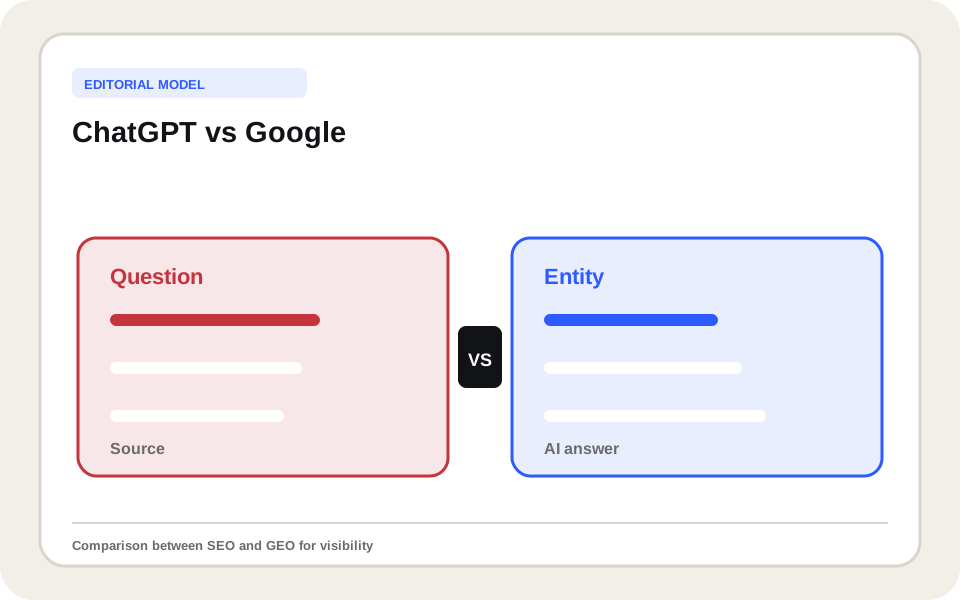
How does the searching itself differ?
In Google the choice stays with the searcher: they see ten results and decide which to open. In ChatGPT that choice has already been made before the searcher sees anything. The model composes an answer and, depending on the mode, shows which sources it used.
| Aspect | ChatGPT | |
|---|---|---|
| Result | A list of links | A composed answer |
| Who picks the source | The searcher | The model |
| What you want to be | High in the list | One of the sources used |
| Repeatability | The same query returns a comparable list | The same conversation can return a different answer |
| Follow-up question | A new query | Continues inside the same conversation |
What is the biggest difference for a business?
That one is measurable and the other is barely. For Google there is Search Console: per query you see impressions, clicks, click-through rate and average position, and you can compare two periods. For ChatGPT no equivalent report exists. You do not know how often somebody asked a question where you were relevant, and there is no position to see.
| What you want to know | ChatGPT | |
|---|---|---|
| Which questions do I appear for? | Search Console lists the queries | Only by asking questions yourself and recording the answers |
| How often was I shown? | Impressions per query | Not available |
| What position do I hold? | Average position | Does not exist, there is no ranking |
| How many visitors did it bring? | Clicks per page | Partly, through referral traffic in your analytics |
| Was I described correctly? | Not applicable | Only by reading the answer |
That last row has no equivalent in Google. In a list of links a result can at most summarise you badly in a snippet. In an AI answer your business can be described with the wrong service, the wrong region or an outdated price, without anyone telling you. How to track that is covered in measuring AI visibility.
Why does a single test in ChatGPT prove nothing?
Because the answer can differ each time. The same question asked a few hours later may use different sources, depending on the mode, the model, the language and what is on the web at that moment. Anyone who tests once and does not see themselves only knows they were not selected at that moment.
A usable measurement therefore works with a fixed list of questions, documented conditions and repetition across several periods. The outcome is a trend, not a score, and it needs the same caveat every time: a handful of questions on one day is an observation, not research.
Do you have to choose between the two?
No, and that is less reassuring than it sounds. Both systems start from web pages that answer a question well. A page Google cannot find is also hard for an AI system to find. The fundamentals are the same, which is exactly why isolated AI tricks return so little.
What does get added is making explicit what a reader infers from context: who you are, where you work, what exactly you deliver and where that can be checked. The difference between the two disciplines is worked out in SEO versus GEO, and the approach itself in what GEO is.
What do we not know yet?
How many buyers actually look for a supplier through an AI assistant. There is no public, reliable measurement of this, and the estimates you find online differ widely without stating a method. Anyone claiming to know what share of search traffic has shifted borrowed that figure from somebody who did not know either.
What you can do is measure your own side: referral traffic from AI domains in your analytics, and a fixed set of questions you repeat every quarter. That is little, but it is yours and it is repeatable.