
What is Meta Muse?
Meta Muse is a personal AI agent from Meta that carries out goals and tasks rather than only answering questions. Every user gets a private virtual computer in the cloud with a full browser, so Muse keeps working when your phone is off, for example to re-check something every week. Meta launched Muse in the United States on September 8, 2026.
| Part | What it does |
|---|---|
| Tasks and goals | Send an email, book a trip or a table, fill in a form, place an order, try to get a refund. |
| Own virtual computer | An isolated cloud computer with a browser, storage and memory. You can step in or take over the browser at any time. |
| Ideas and feed | Muse suggests things based on your conversations and builds a news feed you can steer. |
| Spaces | Your own dashboards inside the app, such as a savings planner or a renovation board, which Muse builds and keeps up to date. |
| Connectors | Links to services such as Instagram, email and calendar. You decide what access each link gets. |
| Channels | The iOS and Android app, the muse.ai website and WhatsApp. Glasses follow later. |
Muse runs on Meta’s own models, which include Muse Spark and Muse Wonder. The agent itself is the app and the service on top. For how ChatGPT looks at businesses, read getting visible in ChatGPT.
When does Muse reach Belgium?
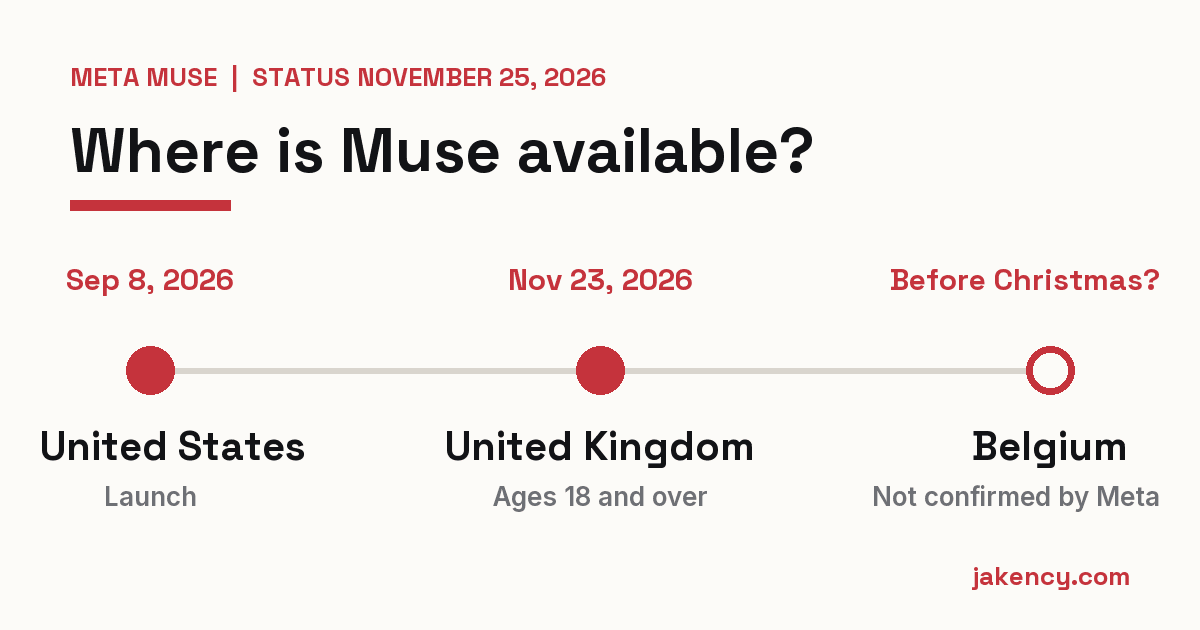
Muse is not officially available in Belgium yet, and Meta has not confirmed a date. The United Kingdom got Muse on November 23, 2026, for everyone aged 18 and over. Belgian news outlets report that Belgium follows within a few weeks, before Christmas. That is an expectation, not a Meta announcement.
| When | Where | What |
|---|---|---|
| September 8, 2026 | United States | Meta launches Muse |
| Autumn 2026 | Canada, Japan and Singapore, among others | Rollout to more countries |
| November 23, 2026 | United Kingdom | Open to anyone 18 or older, on iOS, Android, muse.ai and WhatsApp |
| Expected before Christmas 2026 | Belgium | Not confirmed by Meta |
Opening an account in another country is a poor idea. That country’s terms and privacy rules would apply to you, and Meta may refuse or block the account. Wait for the Belgian launch.
What does Meta Muse cost?
Meta says Muse is free for most of what people need, with optional subscriptions for those who want to do more. Prices and plans for Belgium are not confirmed, and the figures you see online are in dollars and belong to the US launch.
In the United States the plans differ in, among other things, how much you can use each week. What each plan includes, and whether Belgium gets the same, will only be clear after launch. Do not budget on American prices.
How safe is Meta Muse?
Meta describes Muse as an agent that asks for your approval before important actions, such as sending an email or buying something. That is Meta’s own account, and we have not tested it independently. Approvals appear in a screen of the app, not in the chat with Muse itself.
| Topic | What Meta says |
|---|---|
| Approval | A separate security layer decides whether an action may run, or asks you. Read-only and previously allowed low-risk actions go through without asking. |
| Passwords | The model does not see your passwords. Credentials sit in a protected part of your virtual computer. |
| Payments | A one-time card number for one merchant and one amount per purchase. Every payment needs your approval. |
| Advertising | Conversations and data on your virtual computer do not go to advertising systems. Browsing the web can still influence ads indirectly. |
| Training | Conversations can be used to train models. You can switch that off in settings. |
| Memory | You can see what Muse remembers about you, edit it and have it forget. |
| Limits | Meta admits that misleading instructions hidden on a web page (prompt injection) remain an open problem and that Muse can make mistakes. |
The announcement for the United Kingdom says nothing about European privacy rules, and it names no retention period for data. Read the terms for Belgium once they exist, before you let Muse connect to your email or calendar.
What Muse means for your business
For a business, Muse means a customer can send an agent to search, compare, book and buy. The customer asks Muse, and Muse opens websites and reads what they say. A website the agent cannot make sense of drops out before the customer ever sees it. In the United States people already use Muse to compare insurance, book tickets and find shops, and a Belgian customer will soon be able to ask the same.
Meta says Muse does not read pages through the raw code but through a simplified view of the page, the accessibility tree. A button that is a plain div, a form field with no name, or a price that only appears after a script runs barely exists in that view.
Muse can also help with your own channels. In user demos it monitors a Facebook page or Instagram account for angry comments, drafts a reply and waits for approval before posting. That helps if you get many comments, as long as you approve each reply yourself.
According to users, the American version can also phone American businesses. It has not been announced for the United Kingdom or Belgium. For now, expect customers to reach you through Muse by reading your website and profiles, not by phoning you.
How to get your website ready for AI agents
You get your website ready for AI agents with seven changes that also work better for ordinary visitors. They follow from how Meta Muse reads pages, and they help with ChatGPT and Google too. First, check whether you can select the text. If you cannot select a price or a testimonial, it is an image, not text, and an agent will not read it.
- Text in the HTML. Prices, specifications and testimonials sit in the page as plain text and do not load only after a script.
- Names on form fields. Every field has a visible label or an
aria-label, so an agent knows whether it asks for a first name, a phone number or an address. - Alt text on images. Describe what is shown, especially when the image carries information such as a price list or a testimonial.
- Semantic HTML. Use
nav,header,buttonandarticleinstead of a pile ofdivelements. - A definition instead of a slogan. Say what it is, who it is for and what it does. “Your workflow, reimagined” tells an agent nothing.
- An answer with conditions. Agents often answer in the form “pick this if you need that, pick that if you need this”. Write that answer yourself, including who should not choose your service.
- A date on what changes. Put the month and year your prices and terms apply to next to them, and show when the page was last updated.
If you want to manage your business profile in ChatGPT, the steps are in claim your business in ChatGPT.
Which Meta crawlers exist?
Meta documents five crawlers, and robots.txt does not govern all five the same way. Meta-WebIndexer helps Meta point to your content in Meta AI answers. Meta-ExternalFetcher retrieves pages when a user asks and can bypass robots.txt. Whether Muse itself uses that crawler, Meta does not say.
| Crawler | What it is for, according to Meta |
|---|---|
| meta-webindexer | Improving Meta AI search results. Allowing it helps Meta point to your content in answers. |
| meta-externalagent | Crawling the web to train AI models and improve products. |
| meta-externalfetcher | Fetching individual links at a user’s request, including for AI that visits websites to complete tasks. Can bypass robots.txt. |
| meta-externalads | Crawling the web for advertising and other business products. |
| facebookexternalhit | Fetching the title, description and image when someone shares your link on Facebook, Instagram or Messenger. |
Check that your robots.txt or a security rule at your host is not blocking these crawlers by accident. If you want Meta to point to your site, allow meta-webindexer. Whether to allow the training crawler is your company’s call. An agent that fetches a page for a customer may not be stopped by robots.txt.
Common misconceptions about Meta Muse
Figures and promises about Muse circulate that do not hold for Belgium. The table sets the common statements next to what is established.
| Myth | What is true |
|---|---|
| Muse will be available in Belgium within a few weeks. | Meta has not confirmed a Belgian date. Belgian news outlets expect the launch before Christmas. |
| Muse costs 20 euros a month on the paid plan and 100 on the top one. | Those figures come from the US launch and are in dollars. Meta has not confirmed Belgian prices. |
| The paid plans only give you more capacity. | Meta speaks of optional subscriptions for people who want to do more or need more usage. What each plan contains is not confirmed for Belgium. |
| Muse is an AI model. | Muse is the agent and the app. The models underneath include Muse Spark and Muse Wonder. |
| robots.txt keeps Muse out. | Meta documents a user-request crawler that can bypass robots.txt. Whether Muse uses it, Meta does not say. |
What else should you know about Meta Muse?
When is Meta Muse coming to Belgium?
Meta has not confirmed a date for Belgium. Belgian news outlets report that Muse follows before Christmas 2026, after the UK launch on November 23. Until Meta announces it, treat that as an expectation.
Can I use Muse in Belgium today?
No, the official Belgian launch has not happened yet. Wait for it. Signing up through another country or a workaround is a poor idea, because that country’s terms and privacy rules would then apply to you.
Is Meta Muse free?
Meta calls Muse free for most of what people need, with optional subscriptions for those who want to do more. Prices and plans for Belgium are not confirmed. The amounts you see online come from the US launch and are in dollars.
Can Muse pay on my behalf?
Yes, but every purchase needs your approval. Meta says Muse pays with a one-time card number tied to one merchant and one amount. Muse does not see your passwords or card details.
Does Meta use my Muse conversations for advertising?
Meta says conversations and the data on your virtual computer are not shared with its advertising systems. Conversations can be used to train models unless you switch that off in settings. Browsing the web can still influence advertising indirectly.
How do I get my website ready for Muse?
Put prices, specifications and testimonials in plain HTML text, give form fields a name, describe images with alt text and replace slogans with a clear definition. Add the month and year that your prices apply to.