
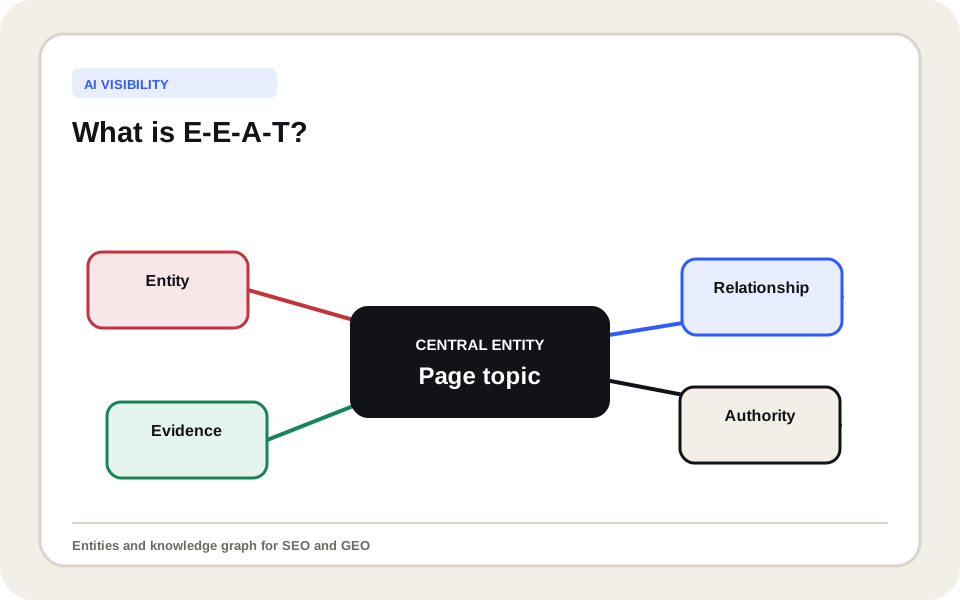
What does E-E-A-T stand for?
Experience, expertise, authoritativeness and trust. For SEO it means you do not only give an answer, but also show why that answer is credible.
| Part | What it means | How you show it |
|---|---|---|
| Experience | Real first-hand experience with the subject | Cases, examples, screenshots and lessons from practice |
| Expertise | Subject knowledge | Deep explanation, correct terms and useful nuance |
| Authoritativeness | Recognition as a source | Mentions, backlinks, an author page and topical authority |
| Trust | Reliability and safety | Contact details, sources, clear claims and transparency |
Which letter weighs most?
The T for trust. The guidelines name trust explicitly as the most important member of the family, with the other three mainly serving to support it. A page can be written by a recognised expert and still be untrustworthy, for instance when the prices are outdated or the company behind the site cannot be found anywhere.
That reverses the order of your work. Anyone starting on E-E-A-T with an author photo starts at the wrong letter. Start with verifiability: are your details correct, do your claims carry a source, and can a reader see who is responsible for what is written.
Where does E-E-A-T come from?
From the Search Quality Rater Guidelines, the public handbook Google gives external raters for judging the quality of search results. The framework was originally E-A-T. The second E, for Experience, was added in December 2022, because first-hand experience is something different from subject knowledge. Someone who actually used a product knows things an expert without that experience does not.
Read the framework in the Search Quality Rater Guidelines. It is not a description of how the algorithm works, but of what Google wants its systems to reward. That distinction matters for the next question.
Is E-E-A-T a ranking factor?
No. E-E-A-T is not a measurable ranking factor like a title tag or an internal link. There is no E-E-A-T score you can retrieve or improve, and quality raters do not change positions. They assess samples that Google uses to evaluate and adjust its systems.
It is therefore a quality framework that helps explain why reliable, complete and demonstrable content can outperform generic content. Anyone selling you an E-E-A-T score, or promising to raise your E-E-A-T with a fixed package, is selling something that does not exist.
For which topics does E-E-A-T weigh most?
For YMYL topics, short for Your Money or Your Life. These are subjects where a wrong answer can harm someone's health, safety, finances or rights. The guidelines demonstrably set the bar higher there than for subjects where a mistake has few consequences.
| Type of topic | Example | What the reader needs |
|---|---|---|
| YMYL, health | What to do during an allergic reaction | A medically supported source and a clear author |
| YMYL, money | Comparing a loan | Current figures, conditions and who stands behind them |
| YMYL, rights | Notice period after dismissal | The law, the date and what does not apply |
| Not YMYL | A pancake recipe | A recipe that works; experience helps |
| Not YMYL | How to tie a tie | Clear steps and images |
That explains why not every page needs the same amount of evidence. A guide on tying a tie does not improve with an extensive author page. A page about a loan does.
How do you improve E-E-A-T on an SEO page?
By making evidence visible. A page gets stronger when it shows who writes, what experience sits behind the advice, which sources were used and how the reader can apply it.
- Add concrete examples, cases or observations from practice.
- Use an author with relevant expertise and a clear author page.
- Link to reliable sources when facts can change.
- Make company details and contact options easy to find.
- Write no vaguer than necessary and avoid claims without evidence.
What goes wrong most often?
That E-E-A-T gets treated as a checklist instead of as a property of the content. These four mistakes recur most.
| Mistake | Why it does not work |
|---|---|
| Adding an author box to the same generic text | The name changes, the content stays interchangeable |
| Crediting an expert who did not write the piece | That is a claim about origin that is not true |
| Adding source links everywhere without the source covering the claim | A link to a topic is not evidence for a figure |
| Claiming experience without any detail | Fifteen years of experience without an example is an adjective |
Why does E-E-A-T matter for AI visibility too?
Because AI systems have to recognise reliable sources. A page with clear entities, sources, author information and practical examples is easier to cite than an anonymous text without evidence. That connects E-E-A-T directly to GEO.