
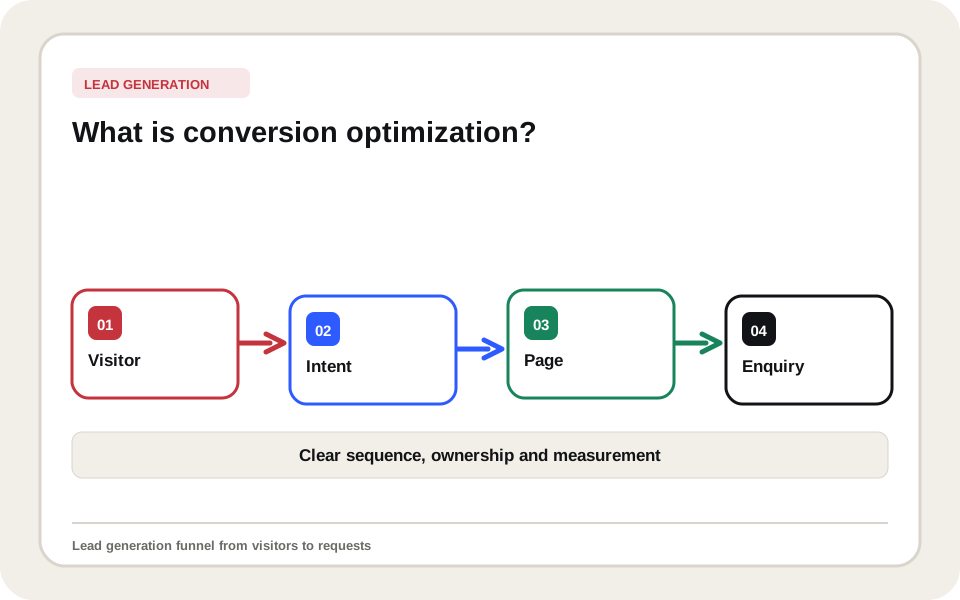
Why is conversion optimization important?
Conversion optimization is important because traffic only becomes valuable when visitors take action. A small improvement in conversion can yield more than purchasing additional traffic or publishing new content.
| Problem | What CRO investigates | Typical solution |
|---|---|---|
| Many visitors, few requests | Intent, offer and CTA | Sharper headline, evidence and form |
| Lots of form starts, few submissions | Friction in form | Fewer fields and better error messages |
| Mobile is performing poorly | Speed, layout and clickability | Simplify mobile flow |
| Lots of bad leads | Qualification and message | Better target group text and selection questions |
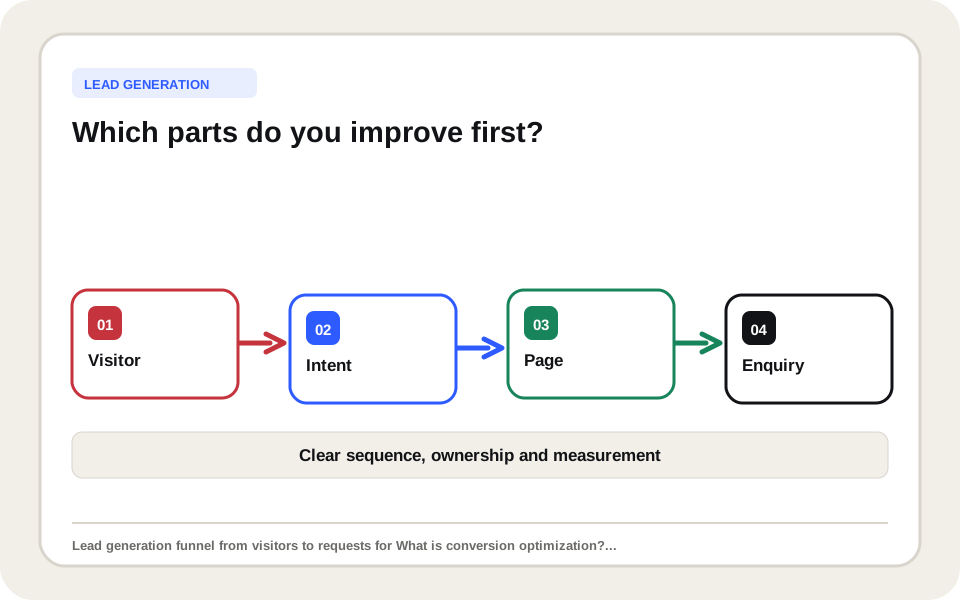
Which parts do you improve first?
You first improve the parts that have a direct influence on trust and action. These are the headline, value proposition, proof, form and CTA.
- Make the H1 directly fit the search intent
- Show evidence with cases, reviews, figures or concrete examples
- Shorten forms to what is necessary for follow-up
- Make the CTA specific and logical
- Check speed and mobile usability
How do you measure conversion optimization?
You measure conversion optimization with conversion rate, lead quality and revenue per channel. More forms alone are not enough when the additional applications are a poor fit.
Combine Google Analytics 4 for SEO with real lead tracking. This way you can see which pages not only get clicks, but also generate good requests.
What is the difference between CRO and SEO?
SEO brings relevant visitors to your website. CRO ensures that those visitors take action. The two reinforce each other: better pages often rank better and convert more strongly at the same time.
That's why conversion optimization is part of lead generation, landing page creation and commercial what is SEO.
Which CRO mistakes cost leads?
CRO mistakes cost leads when they add doubt or friction just as someone is about to take action.
- Too general a headline at the top of the page
- Show no evidence or examples
- Too many required form fields
- Using CTAs that don't say what's happening
- Make mobile buttons and forms too small
How many visitors do you need before you can test?
More than most small-business websites have, and that is the most important practical limit of CRO. To establish a difference between two versions with any certainty you need hundreds of conversions per version, not hundreds of visitors. A page with twenty enquiries a month cannot carry a reliable A/B test.
That does not mean you can do nothing. It means that at that volume you do not run a test but make an improvement and compare the result across longer periods. The difference is honesty about what you know: a change that coincides with more enquiries is an indication, not proof.
| Conversions per month | What you can do | What you may not conclude |
|---|---|---|
| Under 20 | Improve on observation and judgement | That version B beats version A |
| 20 to 100 | One change at a time, compared across quarters | That a ten percent difference is real |
| Over 100 | A/B test with a predetermined runtime | That you may stop as soon as the difference suits you |
That last cell is the most common mistake among those who do have the volume: stopping the test the moment the outcome looks good. Fix the runtime and the required conversions in advance, and only then look.
What do you look at when testing is not possible?
At what visitors actually do, instead of at percentages. These five sources cost nothing and give more direction than a test you cannot support.
- The questions that arrive by form and phone. Repeated questions belong on the page.
- Forms that are started but not finished. That is where the friction sits.
- The pages visitors come from before they make contact.
- What people say in a sales conversation about why they hesitated.
- Your own site on a phone, on a slow connection, as a stranger.