
Why does CRO count next to SEO?
SEO brings visitors to your website. CRO ensures that more of those visitors become customers or leads. Without CRO, additional traffic can be expensive because the same bottlenecks remain in your page.
Which parts do you improve with CRO?
| Part | What you improve |
|---|---|
| Headline and intro | Confirm more quickly that the visitor is sitting correctly |
| CTA | Make it clearer what action follows |
| Form | Delete fields that slow down conversion |
| Evidence | Make reviews, cases and guarantees more visible |
| Speed | Reduce friction on mobile and desktop |
How do you measure CRO?
You measure CRO through conversion rate, form submissions, phone calls, quote requests and revenue per channel. Don't just look at percentages. A lower conversion rate with better lead quality can be commercially stronger.
How does CRO relate to landing pages?
CRO is mainly visible on landing pages. There you determine what message, evidence, and CTAs are needed to turn traffic into real lead generation.
What should you know about CRO?
| Quick fact | Detail |
|---|---|
| Also called | Conversion Rate Optimization, conversion optimization, website conversion optimization |
| Primary source | Google Analytics Help documentation about key events and conversions |
How does CRO work in practice?
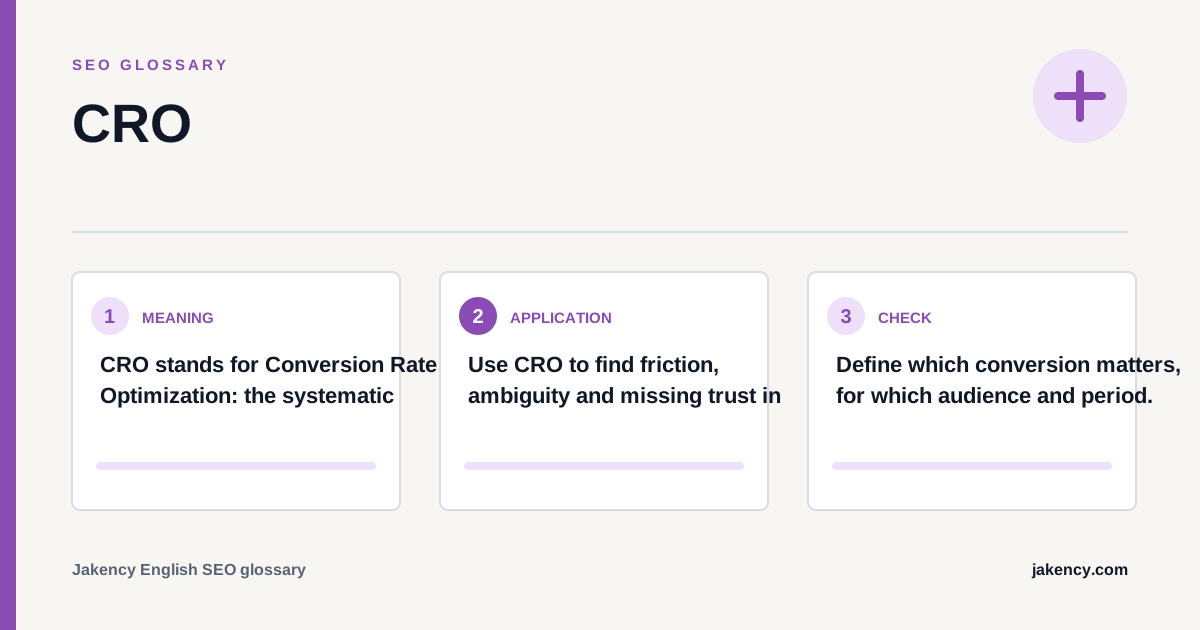
Use CRO to find friction, ambiguity and missing trust in important customer journeys. Combine quantitative data with qualitative research before testing a change.
- Measure the funnel: Track primary conversions, micro conversions, drop-off and segments reliably.
- Research users: Combine analytics with interviews, feedback, session analysis and usability tests.
- Write a hypothesis: State the observed problem, proposed change and expected effect.
- Choose the right test: Use an A/B test, usability test or staged release according to traffic and risk.
- Evaluate business impact: Measure lead quality, revenue, uncertainty and possible side effects.
How do you check CRO?
Define which conversion matters, for which audience and period. Verify tracking, segments, sample size and business quality before drawing conclusions.
- Primary and supporting conversions have precise definitions.
- Consent, duplicate events and self-referrals do not corrupt the data.
- Mobile and desktop journeys are reviewed separately.
- Forms provide understandable labels, errors and confirmation.
- Hypotheses are based on observations rather than taste.
- Results are evaluated for quality as well as volume.
Which mistakes should you avoid with CRO?
Do not optimize only for a higher percentage. Fewer high-quality leads can be more valuable than many unsuitable submissions.
| Mistake | Why it matters |
|---|---|
| Blindly copying best practices | A pattern that works elsewhere may not solve your audience's actual problem. |
| Calling tiny tests conclusive | Insufficient data and many simultaneous variants increase the chance of random outcomes. |
| Separating SEO and CRO | A change can help conversion while harming crawlability, content or search intent. |
How do you measure CRO results?
Use one primary metric with guardrail metrics. Compare segments and periods carefully and document other changes during the experiment.
| Signal | Interpretation |
|---|---|
| Conversion rate | The share of relevant sessions or users completing the defined action. |
| Value per visitor | Combines conversion with order value, lead quality or expected revenue. |
| Guardrail metrics | Protect against unwanted effects on errors, returns, engagement, SEO or support. |
How does CRO relate to other SEO concepts?
CRO rarely operates in isolation. Use the related concepts below to connect this definition with the next technical, content or measurement decision for your website, audience and market.
- CTR: CTR stands for Click-Through Rate and is the percentage of impressions that result in a click.
- search intent: Search intent is the goal a person is trying to achieve with a query, such as learning, comparing, locating or purchasing something.
- Google Search Console: Google Search Console is a free Google service that helps website owners monitor search performance, indexing and technical signals for their website in Google Search.
What is this explanation based on?
The definition and the checks on this page follow the primary source listed at the top. The practical recommendations combine that documentation with page-level SEO analysis. Where the documentation makes no statement, the page says so instead of assuming one.
More questions about CRO
How do you calculate conversion rate?
The common formula is conversions divided by the relevant visitors or sessions, multiplied by 100. Keep the denominator definition consistent.
Is A/B testing always required for CRO?
No. With low traffic, usability tests, qualitative research and staged improvements can be more reliable than an underpowered experiment.
What is a good conversion rate?
It varies widely by offer, channel, intent and definition. Compare primarily with your own reliable baseline and business goal.