
Why does CTR matter for SEO?
Two pages in the same position can have vastly different CTRs depending on how compelling the title and description are. A higher CTR means more visitors from the same position, and may itself be a signal for Google. You improve your CTR with a sharp page title and a promotional meta description, in short, with good copywriting.
What should you know about CTR?
| Quick fact | Detail |
|---|---|
| Also called | Click-Through Rate, click rate, click-through percentage |
| Primary source | Google Search Console Help documentation about clicks, impressions, CTR and position |
How does CTR work in practice?
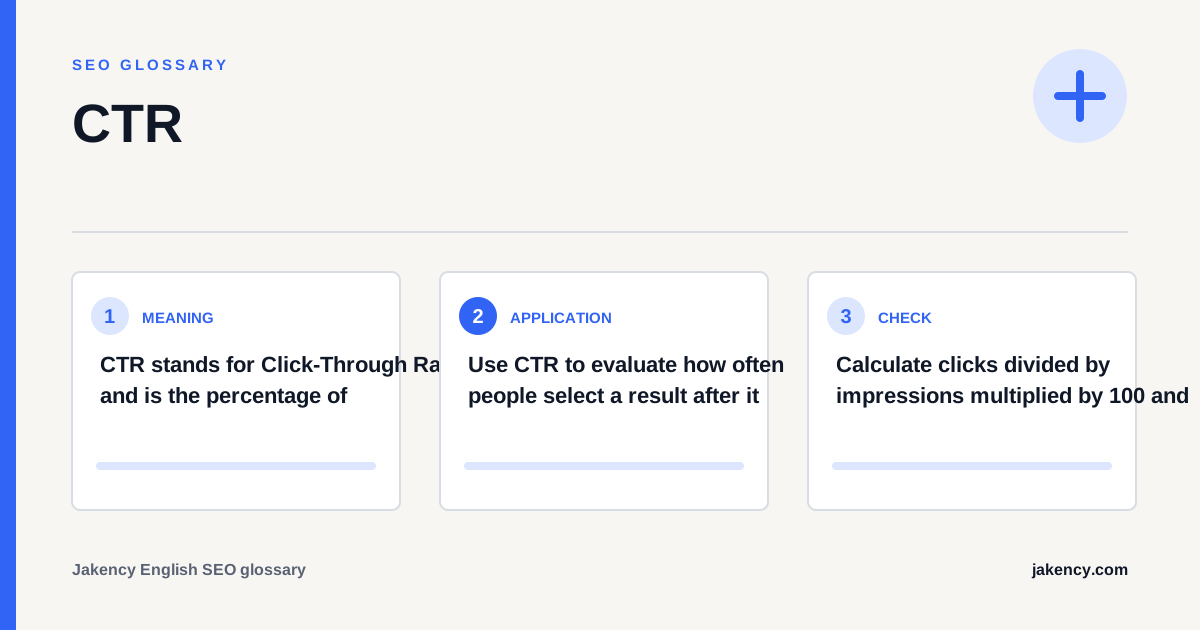
Use CTR to evaluate how often people select a result after it is shown. Always analyze it by channel, query, position, device, country and SERP context.
- Choose the right dataset: Separate organic Search Console data, advertising data, email and other channels.
- Segment the context: Split brand, non-brand, query, page, position, country, device and period.
- Find outliers: Compare similar groups and identify pages with many impressions but low relative CTR.
- Improve relevance: Test title, description, offer and page intent without misleading promises.
- Verify downstream value: Review engagement, lead quality and conversion after the click.
How do you check CTR?
Calculate clicks divided by impressions multiplied by 100 and verify how the platform defines both events. Search Console and Google Ads do not measure identical contexts.
- The formula uses clicks and impressions from the same source and period.
- Branded and non-branded queries are separated.
- Average position and SERP features are considered.
- Desktop and mobile are reviewed separately.
- Title changes are assessed over sufficiently long comparable periods.
- Higher CTR does not create worse lead quality or intent mismatch.
Which mistakes should you avoid with CTR?
Do not compare isolated average CTR values without position and intent. An informational query in position eight has a different pattern from a brand query in position one.
| Mistake | Why it matters |
|---|---|
| Using one good CTR benchmark | Benchmarks vary significantly by channel, position, brand, intent and result type. |
| Claiming CTR proves a ranking factor | A correlation in first-party data does not demonstrate a simple direct ranking rule. |
| Optimizing only the snippet | Position, competitors, features and familiarity also determine click behavior. |
How do you interpret CTR for SEO and advertising?
Use CTR as a diagnostic metric. Combine the percentage with click volume, position, cost and conversion to determine whether a change is genuinely better.
| Signal | Interpretation |
|---|---|
| Organic CTR | Search Console calculates clicks divided by impressions for Google Search data. |
| Advertising CTR | Google Ads measures clicks on ad impressions within the selected campaign context. |
| CTR to conversion | An attractive click promise must align with the landing page and business value. |
How does CTR relate to other SEO concepts?
CTR rarely operates in isolation. Use the related concepts below to connect this definition with the next technical, content or measurement decision for your website, audience and market.
- meta description: A meta description is a short HTML description of a page that Google may use as descriptive text in a search result snippet.
- title tag: The title tag is the HTML title element that names a web page and can be a major source for the clickable title link shown in Google Search.
- CRO: CRO stands for Conversion Rate Optimization: the systematic research and improvement of websites so more suitable visitors complete a desired action successfully.
What is this explanation based on?
The definition and the checks on this page follow the primary source listed at the top. The practical recommendations combine that documentation with page-level SEO analysis. Where the documentation makes no statement, the page says so instead of assuming one.
More questions about CTR
How do you calculate CTR?
The formula is clicks divided by impressions, multiplied by 100. One hundred clicks from 10,000 impressions equals a 1 percent CTR.
What is a good CTR?
It depends on channel, position, query, brand, device and SERP layout. Use comparable first-party segments as the baseline.
Is CTR a Google ranking factor?
Search Console reports CTR as a performance metric. Use it for analysis but do not infer a simple guaranteed ranking factor from it.