
Why does the title tag count?
The page title is a direct ranking factor and at the same time the most visible element in the search results. It largely determines whether people click, and therefore your click-through ratio. Place your main keyword up front and make it attractive, as the core of your on-page SEO.
What should you know about title tag?
| Quick fact | Detail |
|---|---|
| Also called | SEO title, HTML title element, page title |
| Primary source | Google Search Central documentation about title links in search results |
How does a title tag work in practice?
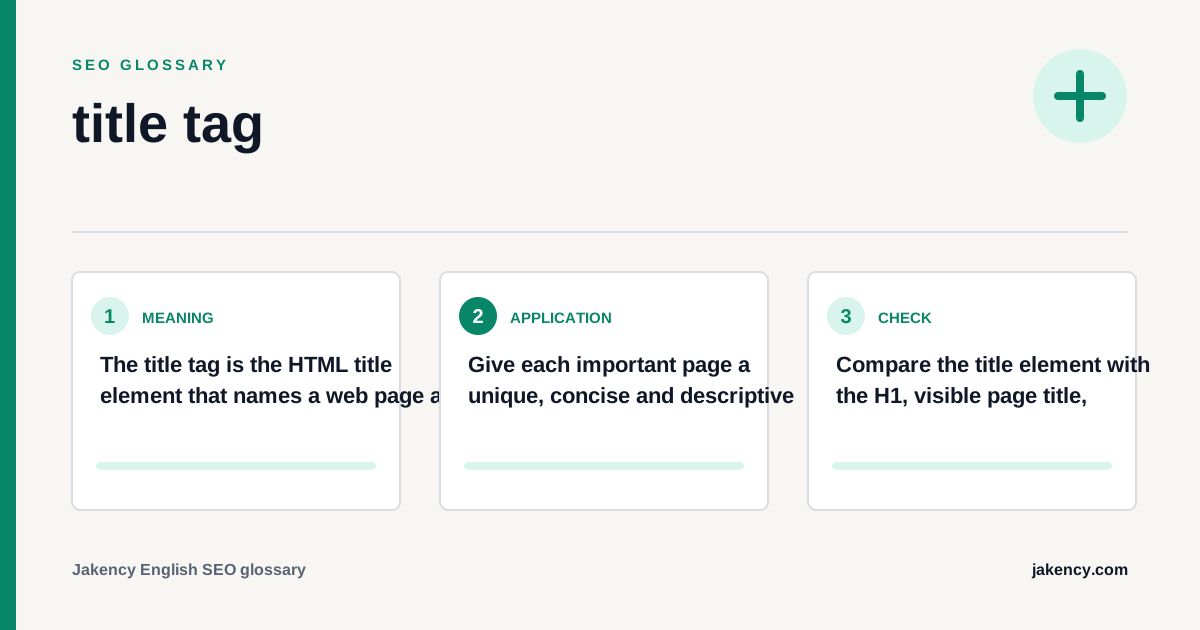
Give each important page a unique, concise and descriptive title that reflects its main topic and useful context. Include the brand where recognition adds value.
- Choose the main topic: Define the unique intent and page content the title must summarize.
- Write descriptively: Combine the primary topic with a useful distinction such as type, location or application.
- Lead with meaning: Keep the essential wording early so the title survives visual truncation.
- Align headings: Let the title and H1 promise the same page without requiring identical wording.
- Monitor rewrites: Review SERP output and improve source signals when Google consistently chooses another title.
How do you check a title tag?
Compare the title element with the H1, visible page title, internal anchors and the title link Google displays for relevant queries.
- Every indexable page has one valid title element.
- The title is unique within the site and describes visible content.
- Primary wording appears naturally and relatively early.
- Brand and boilerplate do not displace the actual topic.
- Title, H1 and internal links provide consistent context.
- Dynamic templates do not generate empty or duplicate titles.
Which mistakes should you avoid with a title tag?
Google can rewrite title links using several sources. Keyword stuffing, stale titles and generic boilerplate increase the chance of a less suitable result.
| Mistake | Why it matters |
|---|---|
| Treating a character count as the goal | Google displays title links by visual width and context, not one guaranteed number of characters. |
| Stacking keywords | Repetition reduces clarity and can prompt a rewritten title link. |
| Disconnecting title and H1 | Conflicting page titles make the main topic less clear to users and systems. |
How do you measure title tag quality?
Evaluate the title together with position, query and snippet. CTR can also change because of competitors, rich results, brand awareness or SERP layout.
| Signal | Interpretation |
|---|---|
| CTR by query and position | Compare performance only within a sufficiently similar search context. |
| Google title link | Check whether Google uses the element or consistently selects other sources. |
| Cannibalization and duplication | Duplicate titles can reveal overlapping pages or faulty templates. |
How does a title tag relate to other SEO concepts?
title tag rarely operates in isolation. Use the related concepts below to connect this definition with the next technical, content or measurement decision for your website, audience and market.
- meta description: A meta description is a short HTML description of a page that Google may use as descriptive text in a search result snippet.
- CTR: CTR stands for Click-Through Rate and is the percentage of impressions that result in a click.
- search intent: Search intent is the goal a person is trying to achieve with a query, such as learning, comparing, locating or purchasing something.
What is this explanation based on?
The definition and the checks on this page follow the primary source listed at the top. The practical recommendations combine that documentation with page-level SEO analysis. Where the documentation makes no statement, the page says so instead of assuming one.
More questions about title tag
How long can a title tag be?
There is no fixed character limit. Write concisely and put the main meaning early because Google can truncate title links according to available visual space.
Should the title tag and H1 be identical?
No, but they should support the same main topic and expectation. Small variations can be natural and useful.
Why does Google rewrite my title tag?
Google can use title elements, visible headings, prominent text and link labels to produce a suitable title link for a result.
Open Graph metadata defines a page-specific title, description, image and object URL for link previews. Keep those fields consistent with the visible page, canonical URL, language and structured entity data.