
Why does crawl budget matter?
Waste your crawl budget on unimportant or erroneous pages (think lots of 404 errors or duplicate URLs), and you'll have less left for your valuable pages. You send it with robots.txt, a neat structure and strong internal links.
What should you know about crawl budget?
| Quick fact | Detail |
|---|---|
| Also called | Googlebot crawl capacity, crawl demand, crawl allocation |
| Primary source | Google crawl budget documentation for owners of large websites |
How does crawl budget work in practice?
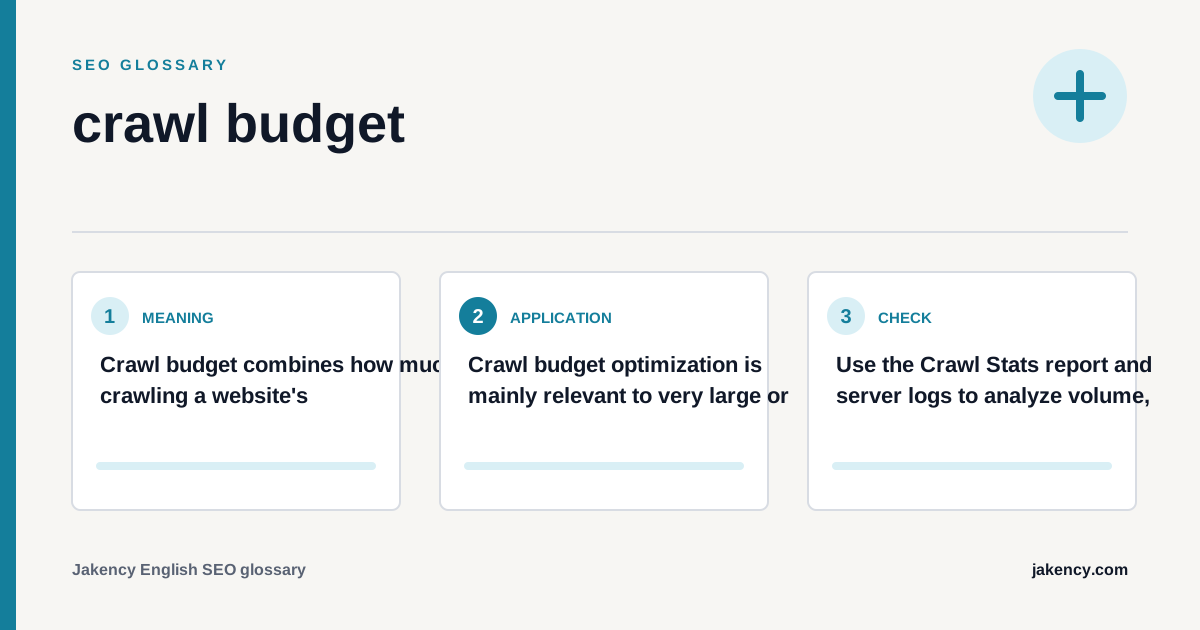
Crawl budget optimization is mainly relevant to very large or rapidly changing websites and sites that generate many unwanted URL variants. Smaller sites usually benefit more from stronger content and internal linking.
- Confirm a scale problem: Compare useful URLs with unwanted parameters, filters and duplicate variants.
- Check server health: Resolve slow responses, timeouts and 5xx errors that restrict crawling.
- Reduce crawl waste: Control infinite URL spaces, session parameters and unnecessary duplicates.
- Strengthen discovery: Use internal links, reliable sitemaps and accurate lastmod values for priority pages.
- Analyze server logs: Measure which bots visit which URLs and where available activity is spent.
How do you check crawl budget?
Use the Crawl Stats report and server logs to analyze volume, response times, status codes and requested URL patterns. Also verify that important new and updated pages are crawled promptly.
- Important pages are crawled regularly and after meaningful updates.
- Server responses remain fast with few 5xx errors.
- Parameters and filters do not create unlimited URL spaces.
- Internal links guide crawlers to current canonical pages.
- Sitemaps contain useful URLs with trustworthy lastmod values.
- Old and duplicate URLs do not consume most crawl activity.
Which mistakes should you avoid with crawl budget?
Do not confuse crawl activity with indexing or rankings. More Googlebot requests do not automatically mean more pages will be indexed or rank higher.
| Mistake | Why it matters |
|---|---|
| Optimizing without a scale issue | For a small site, improving content often creates much more value than managing crawl volume. |
| Blocking everything in robots.txt | This can prevent diagnosis, signal consolidation and the discovery of noindex instructions. |
| Treating crawl budget as a fixed number | Crawl capacity and demand change with server health, quality and freshness. |
How do you measure crawl budget and crawl waste?
Review patterns over time and segment activity by URL type. A single total without separating valuable and unwanted URLs provides little insight.
| Signal | Interpretation |
|---|---|
| Crawl requests by page type | Shows how activity is distributed across products, articles, filters and errors. |
| Response time and server errors | Slow or unstable servers can reduce available crawl capacity. |
| Time to recrawl | Measures how quickly important new or updated pages are revisited. |
How does crawl budget relate to other SEO concepts?
crawl budget rarely operates in isolation. Use the related concepts below to connect this definition with the next technical, content or measurement decision for your website, audience and market.
- robots.txt: Robots.txt is a public text file at the root of a host that tells specified crawlers which paths they may or may not request.
- XML sitemap: An XML sitemap is a machine-readable file listing URLs that a website wants search engines to discover and crawl.
- canonical tag: A canonical tag is an HTML link element that identifies the URL a website considers the preferred version of identical or very similar content.
What is this explanation based on?
The definition and the checks on this page follow the primary source listed at the top. The practical recommendations combine that documentation with page-level SEO analysis. Where the documentation makes no statement, the page says so instead of assuming one.
More questions about crawl budget
Does every website have a crawl budget?
Google schedules crawling for every site, but its crawl budget guidance is mainly relevant to very large or rapidly changing websites.
Does an XML sitemap increase crawl budget?
A sitemap helps signal important URLs and changes but does not create a guaranteed additional quota or replace website quality.
Can nofollow improve crawl budget?
Nofollow is not a reliable tool for managing internal crawl budget. Fix unnecessary URL spaces, duplication and architecture at their source.