
What do we know about the November 2026 core update?
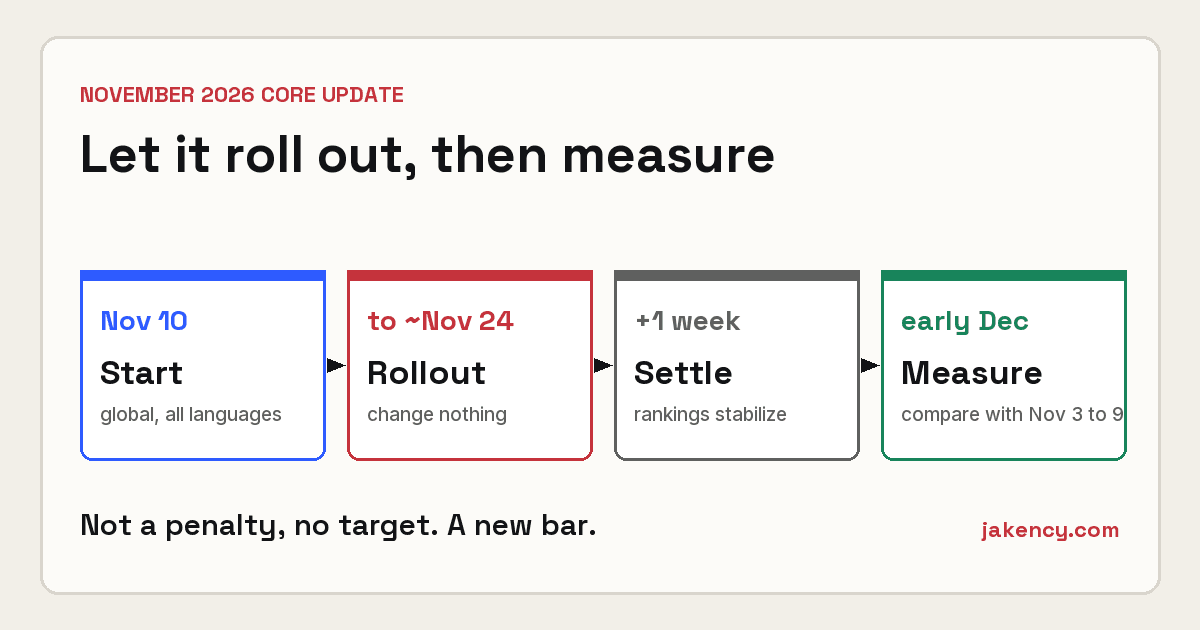
Google announced on November 10, 2026 that the November core update had started. It applies to all languages worldwide and may take up to two weeks to roll out. Google calls it a regular update meant to better surface relevant, satisfying content from all kinds of sites. It did not name any target, industry or type of page.
| Item | Confirmed | What it does not mean |
|---|---|---|
| Start | November 10, 2026, around 10 a.m. Pacific | That every ranking change since then is the update |
| Scope | Global, all languages | That every market or query moves the same way |
| Rollout | Up to two weeks, so done around November 24 | That affected sites recover within two weeks |
| Place in 2026 | Third core update, after March (March 27 to April 8) and May (May 21 to June 2) | That nothing changed in between: three spam updates ran too |
| Target | None: core updates do not target specific sites | That a drop is a penalty |
Three spam updates landed between the May and November core updates, in June, August and September. If you lost traffic during that stretch, keep that data separate. Our guide to the September 2026 spam update covers how to read it.
What is a Google core update?
A Google core update is a broad change to the systems that decide which pages Google shows for a query and in what order. It is not a penalty, and it is not a list of banned tactics. Google reassesses how well pages answer a query, measured against everything else that has been published since the last update.
Think of it this way: your page did not get worse, the bar moved. Another page now answers the question more completely, or Google reads the query differently. Core updates also touch Discover and featured snippets, not just the regular search results page.
A manual action is a different thing entirely. It follows a human review and shows up in Search Console under Security and Manual Actions. If that report is empty, you do not have one.
What should you avoid during the rollout?
Leave your pages alone while the rollout is running, unless something is genuinely broken. Rankings bounce around in this window. If you rewrite titles, copy or links now, you will never know whether the update or your edit made the difference.
- Do not delete or merge pages based on a few days of data.
- Do not bump a date without changing the content. That is not an update.
- Do not buy or disavow links in a panic.
- Do fix real errors straight away: pages returning errors, an accidental noindex, a hacked page, a wrong price.
When and how should you measure the impact?
Wait until the rollout is complete, then let one more full week pass. Compare that week with the week before November 10, which is November 3 to 9. That way you compare a settled week with a normal one.
| Period | What to do |
|---|---|
| November 3 to 9 | Baseline week. Export Search Console data by page and query. |
| November 10 to about 24 | Rollout. Change nothing except real errors. |
| The week after | Let it settle. |
| From early December | Compare a full week with the baseline. |
Watch the calendar. Thanksgiving falls on November 26, Black Friday on November 27 and Cyber Monday on November 30. For an online store, demand looks nothing like a normal week. For a law firm or a plumber, much less so. If you have last year’s data for the same weeks, compare against that too.
How do you investigate a drop in five steps?
Work through Google Search Console from broad to narrow: the whole site first, then pages, then queries.
- Whole site or a few pages? Check the total in Performance, then the Pages tab.
- Impressions or clicks? Falling impressions mean lost positions. Falling clicks with steady impressions mean the results page changed, for example because an AI Overview now sits above you.
- Which queries? Click a page that dropped and open the Queries tab. Are these your money queries or side traffic?
- Who ranks now? Search those queries yourself. What do the pages that passed you answer that yours does not?
- Real error or reshuffle? Check the indexing report and manual actions. If both are clean, the question is how well your page answers the query.
What do we check first after any drop?
After a core update, we look at the same five things first. None of them is specific to this update, but in practice they explain most of the movement we see.
| Check | What we look at |
|---|---|
| The answer | Does the page answer the query in its opening lines, or is the answer buried? |
| What every top page covers | Does the page cover what every good page on the topic covers, and then add something of its own? |
| One page per query | Are several of your own pages competing for the same query? See keyword cannibalization. |
| Topic fits the site | Does every page fit what the site is known for, or are there detours? |
| Current information | Are prices, rules and figures still correct, with a year attached? |
Showing real experience and expertise helps, but E-E-A-T is not a setting you can tweak. It describes what good content looks like.
Does the core update affect AI Overviews?
Google said nothing about AI Overviews or AI Mode in its announcement. What we do know: a page that does not rank is rarely used as a source in an AI answer. Lose your position on a query and you usually lose your shot at being cited for it as well.
So track two things separately: your rankings in Search Console, and whether you are mentioned in Google’s AI answers and in ChatGPT. Our page on ChatGPT visibility explains how.
What do people get wrong about core updates?
| Misconception | What is true |
|---|---|
| Core updates put extra weight on E-E-A-T | E-E-A-T is not a ranking factor. It comes from the rater guidelines and describes what trustworthy content looks like. |
| A drop means you were penalized | Core updates are not penalties and do not target sites. Manual actions show up separately in Search Console. |
| You need to overhaul your site immediately | Wait for the rollout plus a week. Only then can you see which pages and queries really changed. |
| You can only recover at the next core update | Improvements can show up in between, though there is no set timeline. |
| Updating the date on a page helps | A new date without new content is not an update. Only real content changes count. |
What else should you know about this core update?
When did the November 2026 core update start?
Google began the rollout on November 10, 2026, at about 10 a.m. Pacific time. It applies globally to all languages and may take up to two weeks. It is the third core update of 2026, after the March and May updates.
Is a drop during a core update a penalty?
No. Core updates are not penalties and do not target specific sites or pages. Google reassesses how well results answer a query. A manual action is a separate thing, and Search Console reports it under Security and Manual Actions.
When can I measure the impact?
After the rollout ends and at least one full week has passed. Then compare that week with the week before November 10. If your comparison week lands on Thanksgiving, Black Friday or Cyber Monday, account for seasonal demand.
Should I change my content now?
Not during the rollout. Changing pages while rankings are still moving makes it impossible to tell what made the difference. Fix genuine errors right away, such as a broken page or an accidental noindex.
Do I have to wait for the next core update to recover?
Improvements can show up between core updates, but there is no set timeline. Larger shifts often coincide with the next core update. Judge changes over complete, comparable periods.
Is this update about E-E-A-T?
E-E-A-T is not a ranking factor in itself. It comes from Google’s quality rater guidelines and describes what trustworthy content looks like. Content that shows real experience and expertise aligns with what Google wants to reward, but there is no E-E-A-T dial to turn.