
Why does anchor text count?
Anchor text is a relevance signal, both for internal links and for backlinks. Use descriptive, natural anchor text that matches the landing page, without forcefully repeating the same keyword. It is a core part of your internal link structure and your linkbuilding.
What should you know about anchor text?
| Quick fact | Detail |
|---|---|
| Also called | link text, hyperlink text, link label |
| Primary source | Google Search Central documentation about crawlable links and good anchor text |
How does anchor text work in practice?
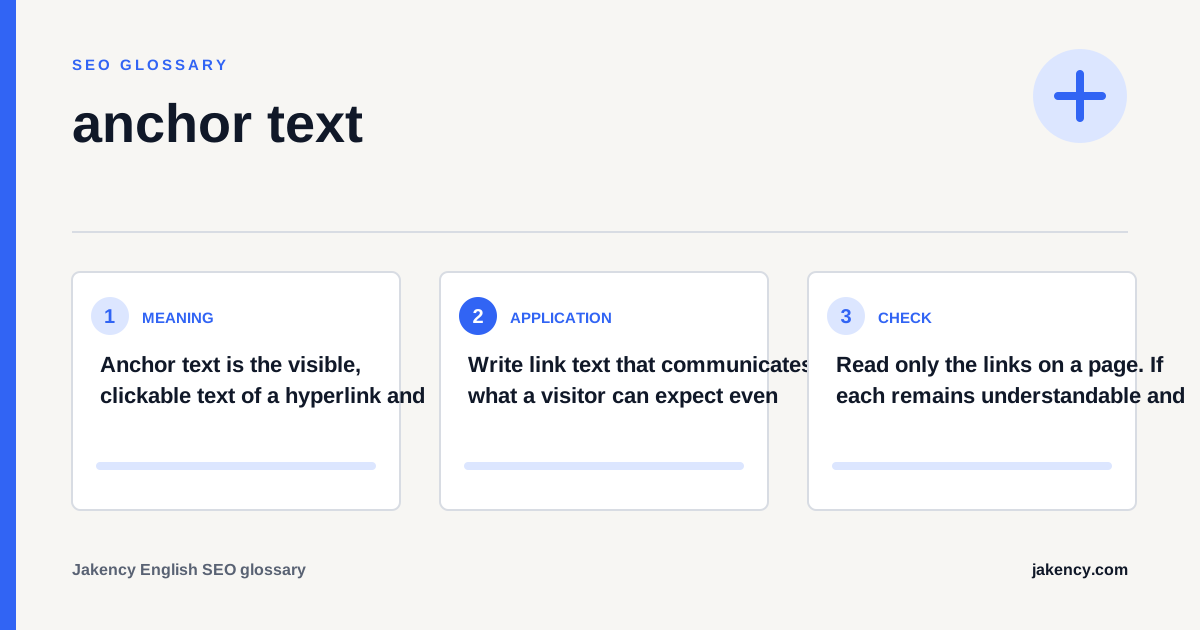
Write link text that communicates what a visitor can expect even outside the surrounding sentence. Vary it naturally with context instead of forcing exact-match keywords.
- Choose the destination: Select the page that best satisfies the reader's next information need.
- Describe the target: Use a few concrete words that summarize its topic and expected value.
- Add contextual relevance: Let the surrounding sentence explain why the reference is useful.
- Distinguish links: Avoid using the same generic text for unrelated destinations.
- Audit sitewide patterns: Review internal anchors for inconsistency, overuse and missing routes.
How do you check anchor text?
Read only the links on a page. If each remains understandable and distinguishable, the anchor text supports navigation, accessibility and topical relationships.
- The link text describes the destination without exposing the URL.
- The wording is concise, natural and grammatically part of the sentence.
- Important internal pages receive contextually relevant references.
- Linked images have descriptive alt text when it acts as the anchor.
- Identical labels do not confusingly lead to different destinations.
- The content contains no hidden or misleading links.
Which mistakes should you avoid with anchor text?
Generic labels such as 'click here' and links covering whole paragraphs provide little precision. Repeated commercial exact-match anchors can also look unnatural.
| Mistake | Why it matters |
|---|---|
| Using only 'read more' | Without extra context, the next topic or document is unclear. |
| Forcing exact-match keywords | Unnatural repetition harms readability and can appear manipulative. |
| Ignoring surrounding context | Users and search engines use both the anchor and nearby text to understand the relationship. |
How do you evaluate anchor text?
Do not chase one ideal ratio of anchor types. Check whether important pages receive logical support and whether link labels make the information architecture clear.
| Signal | Interpretation |
|---|---|
| Internal anchor variation | Shows the language and contexts used to reference an important page. |
| Click behavior | Analytics and user research reveal whether links are used where expected. |
| Orphan pages | Pages without crawlable internal links lack both context and a normal discovery route. |
How does anchor text relate to other SEO concepts?
anchor text rarely operates in isolation. Use the related concepts below to connect this definition with the next technical, content or measurement decision for your website, audience and market.
- backlink: A backlink is a hyperlink on another website that points to a page on your website.
- search intent: Search intent is the goal a person is trying to achieve with a query, such as learning, comparing, locating or purchasing something.
- nofollow: Nofollow is a value in a link's rel attribute that tells search engines the publisher does not want to endorse the linked page or relationship in the normal way.
What is this explanation based on?
The definition and the checks on this page follow the primary source listed at the top. The practical recommendations combine that documentation with page-level SEO analysis. Where the documentation makes no statement, the page says so instead of assuming one.
More questions about anchor text
Should anchor text exactly match the target keyword?
No. Use descriptive language that fits the sentence and destination naturally. Relevance and clarity matter more than exact repetition.
Does image alt text count as anchor text?
For a linked image, alt text can provide context about the link. Describe its function and destination usefully.
Are URLs good anchor text?
A visible URL can be appropriate in a source citation, but descriptive wording is usually easier to read and understand.
Internal linking connects pages on the same website through crawlable, relevant routes. Review the definition, anchor-text guidance, architecture examples and audit checklist before changing links at scale.