
Why do backlinks count?
Google sees a backlink as a vote of confidence. Quality and relevance take precedence over number: a few strong, thematically appropriate links outweigh more than a hundred weak ones. You build them with link building as part of your off-page SEO. You can remove harmful links, see removing toxic backlinks.
What should you know about backlink?
| Quick fact | Detail |
|---|---|
| Also called | inbound link, incoming link, external link to your site |
| Primary source | Google Search Essentials documentation about link spam and other spam practices |
How does a backlink work in practice?
Relevant links can help users and crawlers discover a page and provide context about a source, organization or topic. Quality depends on the real placement and relationship, not one numeric metric.
- Create a link-worthy source: Publish original data, expertise, tools or explanations that others genuinely want to reference.
- Find relevant contexts: Identify trade media, partners, organizations and pages where the source adds real value.
- Explain the value: Approach a publisher with a specific reason the source benefits its audience.
- Verify the placement: Review destination, context, attributes and accessibility after the reference goes live.
- Measure beyond counts: Track discovery, relevant traffic, brand mentions and search performance without claiming simple causality.
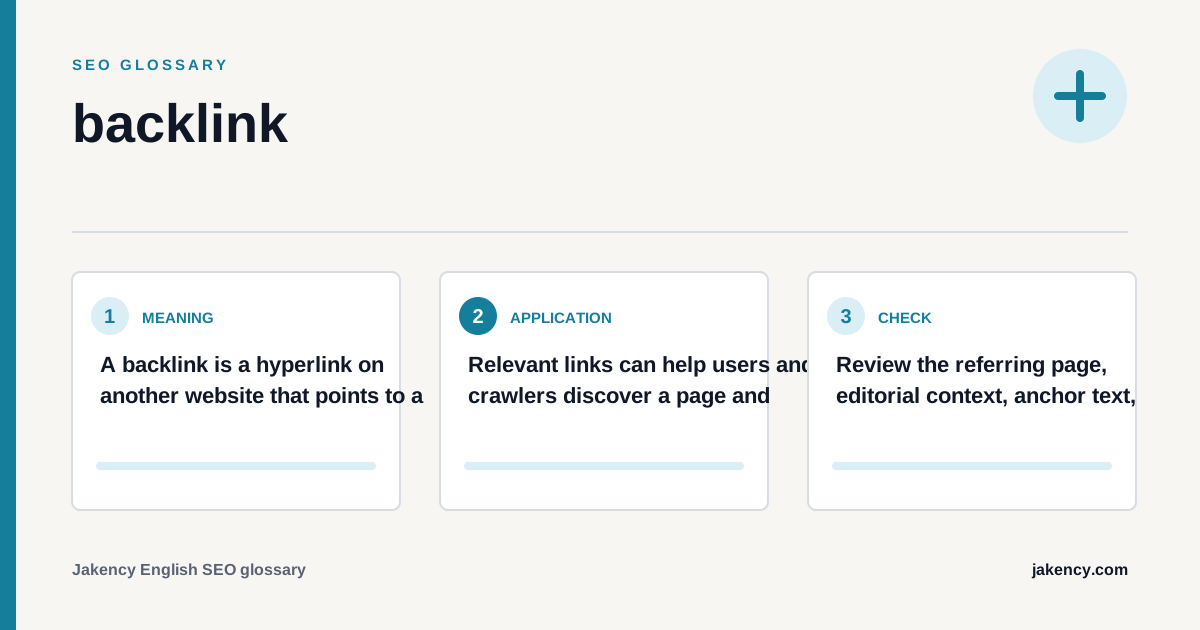
How do you check a backlink?
Review the referring page, editorial context, anchor text, link attribute, destination and likely usefulness to real visitors.
- The referring page and website are topically relevant.
- The link appears visibly in editorial context and helps the reader.
- The destination is the most appropriate canonical page.
- Sponsored or user-generated links use a suitable rel attribute.
- The link is crawlable and not hidden behind broken scripting.
- The referring page is accessible and not an obvious spam construction.
Which mistakes should you avoid with a backlink?
Do not buy or exchange links primarily to manipulate rankings. Paid placements should be qualified appropriately and must not be presented as independent editorial recommendations.
| Mistake | Why it matters |
|---|---|
| Counting all links equally | A relevant editorial citation and a random profile or spam link do not provide the same context. |
| Treating tool scores as Google scores | Domain Authority and similar metrics are third-party models, not Google metrics. |
| Pointing everything to the homepage | A specific resource, case study or service page may be much more useful to the visitor. |
How do you analyze backlinks?
Combine Search Console with a third-party link index and manual review. No tool sees every link, and growth in links does not automatically prove the cause of a ranking change.
| Signal | Interpretation |
|---|---|
| Relevant referring domains | Group genuine independent sources and avoid overcounting sitewide links. |
| Linked destination pages | Shows which content earns external recognition and discovery. |
| Referral traffic and conversion | Measures whether visitors arrive through the link and take a meaningful next step. |
How does a backlink relate to other SEO concepts?
backlink rarely operates in isolation. Use the related concepts below to connect this definition with the next technical, content or measurement decision for your website, audience and market.
- anchor text: Anchor text is the visible, clickable text of a hyperlink and gives users and search engines context about the linked destination.
- nofollow: Nofollow is a value in a link's rel attribute that tells search engines the publisher does not want to endorse the linked page or relationship in the normal way.
- Domain Authority: Domain Authority is a predictive score from 1 to 100 developed by Moz to estimate a domain's relative ranking potential using data and models from Moz's own link index.
What is this explanation based on?
The definition and the checks on this page follow the primary source listed at the top. The practical recommendations combine that documentation with page-level SEO analysis. Where the documentation makes no statement, the page says so instead of assuming one.
More questions about backlink
Are backlinks still important for SEO?
Links remain useful for discovery, navigation and context. Their effect depends on quality, relevance, destination and the wider website.
How many backlinks do you need?
There is no universal number. Compare genuine source quality and authority context within your market instead of chasing raw counts.
Is every paid backlink prohibited?
Advertising and sponsorship are possible, but Google says links that are part of paid placements should be qualified with rel=sponsored or nofollow.