
Why does domain authority matter?
Higher authority usually correlates with better rankings, mainly due to strong backlinks. But it's a third-party estimate, not a number Google uses. Focus on the underlying quality: relevant links and good content via off-page SEO and linkbuilding.
What should you know about Domain Authority?
| Quick fact | Detail |
|---|---|
| Also called | DA, domain authority score, authority metric |
| Primary source | Moz documentation explaining its Domain Authority metric |
How does Domain Authority work in practice?
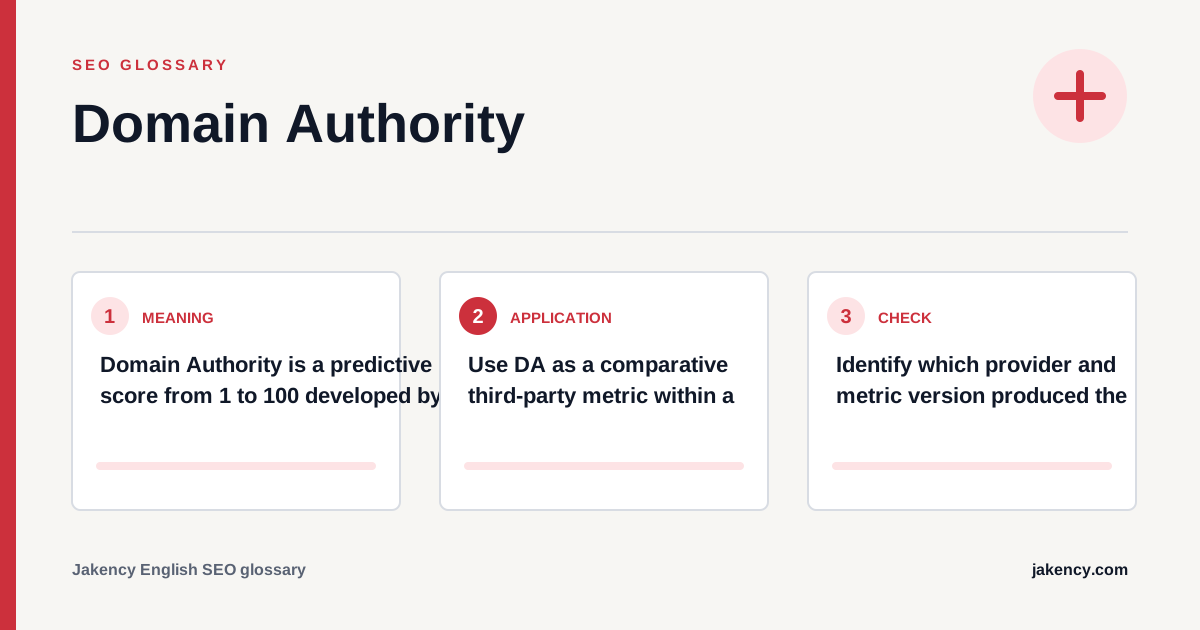
Use DA as a comparative third-party metric within a relevant market and consistent data source. Always combine it with actual link quality, organic performance, content and technical health.
- Choose one data source: Compare scores from the same tool because models and link indexes differ.
- Define real competitors: Use websites competing for the same market and search intents.
- Inspect underlying links: Review relevant domains, destination pages and link contexts behind the score.
- Connect it to search performance: Compare visibility, query coverage and content quality instead of only the metric.
- Track trends cautiously: Tool updates and index changes can move scores without an actual website change.
How do you check Domain Authority?
Identify which provider and metric version produced the score, when its data was updated and how relevant competitors in the same niche compare.
- The score is attributed to a named third-party SEO tool.
- Comparisons use the same tool, market and period.
- Underlying referring domains receive manual quality review.
- Strong content sections are considered separately from the domain total.
- Google Search Console remains the source for first-party Google performance.
- Decisions do not depend on one composite score.
Which mistakes should you avoid with Domain Authority?
Do not call Domain Authority a Google score or direct ranking factor. Google does not use this third-party metric in its search results.
| Mistake | Why it matters |
|---|---|
| Presenting DA as a ranking factor | The score is an external prediction and is neither calculated nor used by Google. |
| Mixing tool scores | DA, DR and Authority Score use different data and formulas and are not equivalent. |
| Making a higher score the business goal | A tool metric does not create customers without relevant pages, visibility and conversion. |
How should you use authority metrics responsibly?
Use them as diagnostic and comparison signals. The business objective remains relevant organic visibility and outcomes, not maximizing a vendor's score.
| Signal | Interpretation |
|---|---|
| Relative score | Compare real competitors and do not interpret small differences as absolute quality. |
| Relevant link growth | Determine whether new independent sources fit the topics and audiences. |
| Organic performance | Clicks, impressions, positions and conversions show what happens in Google and with users. |
How does Domain Authority relate to other SEO concepts?
Domain Authority rarely operates in isolation. Use the related concepts below to connect this definition with the next technical, content or measurement decision for your website, audience and market.
- backlink: A backlink is a hyperlink on another website that points to a page on your website.
- nofollow: Nofollow is a value in a link's rel attribute that tells search engines the publisher does not want to endorse the linked page or relationship in the normal way.
- Google Search Console: Google Search Console is a free Google service that helps website owners monitor search performance, indexing and technical signals for their website in Google Search.
What is this explanation based on?
The definition and the checks on this page follow the primary source listed at the top. The practical recommendations combine that documentation with page-level SEO analysis. Where the documentation makes no statement, the page says so instead of assuming one.
More questions about Domain Authority
Does Google use Domain Authority?
No. Domain Authority is a Moz metric. Google does not use this external score as a ranking factor.
What is a good Domain Authority score?
There is no universally good score. The metric is relative and best compared with relevant competitors in the same niche and tool.
What is the difference between DA and DR?
DA is a Moz metric and DR is an Ahrefs metric. Each models domain strength with its own link index and formula, so the scores are not interchangeable.