
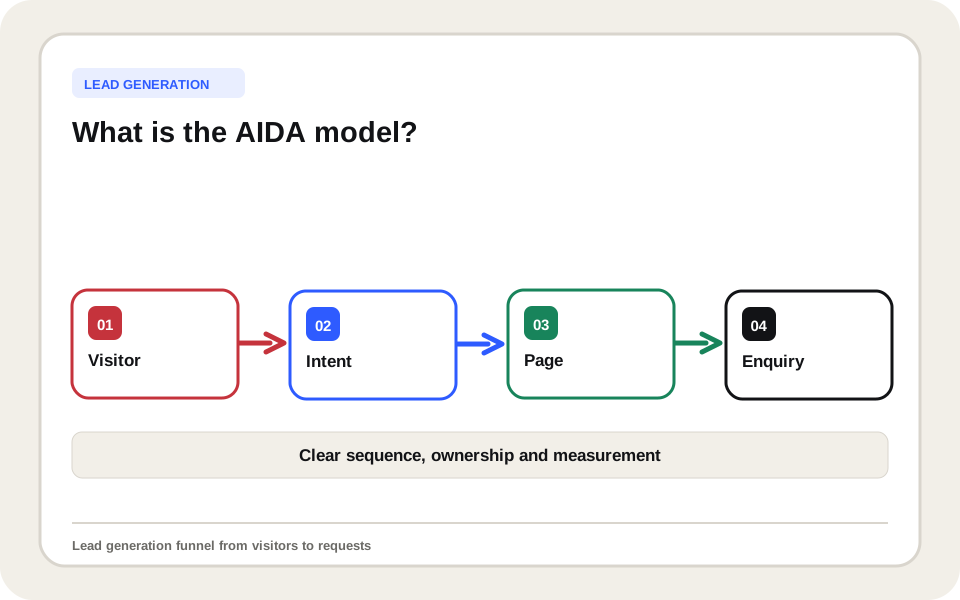
What does AIDA stand for?
AIDA stands for Attention, Interest, Desire and Action: get noticed, hold interest, build preference and ask for an action. The sequence is attributed to the American advertising executive Elias St. Elmo Lewis, who formulated it around 1898 for sales letters and advertisements. The fourth step, action, was added to the original three later. The model is older than radio, television and search engines combined, which explains exactly where it rubs against SEO.
| Step | Goal | Question the reader asks |
|---|---|---|
| Attention | Get noticed | Is this about my question? |
| Interest | Show relevance | Does this provider understand my situation? |
| Desire | Build preference | Why would I choose this? |
| Action | Make the step easy | What should I do now? |
Why does AIDA work differently in SEO than in advertising?
Because your reader does not start cold. An advertisement interrupts someone who asked for nothing, so the copy has to win attention first. A searcher just typed the question. The attention already exists, and the only question is whether your result earns the click against nine others.
That moves the first two steps off your page. Attention is won or lost in the search results, through your title tag and your meta description. Interest is decided in the first two sentences after the click, before the reader has scrolled. Only after that does the space the classic model imagines actually begin.
| Step | Where it happens | What decides it |
|---|---|---|
| Attention | In the search results, before the click | Title tag, URL, rich result and the competition around it |
| Interest | The first two sentences of the page | Whether the answer is there immediately or delayed |
| Desire | The main content | Evidence, figures, examples and what you do not promise |
| Action | After the answer | Whether the next step matches the search intent |
When does AIDA make an SEO page worse?
When you take the order literally. The model says you build desire before asking for the action, which tempts writers to push the answer down the page. For a searcher that is exactly backwards: anyone who does not find the answer in the first paragraph returns to Google. A page that saves the answer until after the persuasion loses the reader, and it also becomes ineligible for a featured snippet, because that requires a passage that reads correctly on its own.
The fix is not to discard AIDA but to place Desire after the answer instead of before it. Give the plain answer first, then use the rest of the page to prove it. The model stays intact; only A and D swap places.
- No shouting headline for informational intent, because it promises something the page does not deliver.
- No build-up towards the answer, but an answer with the build-up underneath it.
- Make Desire concrete with figures, a measurement date and an example, not with adjectives.
- Let Action follow from what the reader just read, not from what you want to sell.
What does that look like in practice?
Take a service page about outsourcing SEO. In the classic AIDA order it opens with a promise, builds tension and ends at the price. In the reversed order the answer comes first and the rest of the page does the convincing.
| Part | Classic AIDA | Answer first |
|---|---|---|
| First sentence | Do you finally want to rank higher in Google? | Outsourcing SEO usually costs between a few hundred and a few thousand euro per month, depending on scope and market. |
| Then | An explanation of why SEO matters | Where that amount comes from and what it includes |
| Evidence | At the bottom, if present at all | In the middle, with a source and a date |
| Action | Straight after the promise | After the answer, as the logical next step |
The second column reads more commercially. The third wins more often, because it answers the question the reader actually asked. What that means for a service page is covered in SEO copywriting, and for a conversion page in landing pages.
Which models do you use next to AIDA?
AIDA is one of several orders, and none of them is better in general. The search intent decides which one fits. For a question starting with what or how, a definition with elaboration beats a sales sequence.
| Model | Order | Fits |
|---|---|---|
| AIDA | Attention, interest, desire, action | A commercial page with a clear offer |
| PAS | Problem, agitate, solve | A reader who already feels the problem |
| Answer first | Answer, evidence, nuance, next step | Informational and comparison intent |
| Comparison | Criteria, options, trade-off, choice | Someone choosing between providers or methods |
Is AIDA a ranking factor?
No. AIDA is a writing model, not a signal Google measures. There is no Google documentation that names a text structure as a ranking factor. What counts is whether the page answers the query completely and verifiably. A model that helps you do that is useful; a model that gets in the way of the answer is not. Judge the result on positions, clicks and enquiries, not on whether you ticked off four letters.
For conversion pages AIDA fits well with landing page creation and conversion optimization.